更多科大概覽


1月3日
11:00am - 12:00pm
研討會, 演講, 講座

The problems that are most frequently solved in scientific and engineering computing may probably be the elasticity equations. The finite element method (FEM) was invented in analyzing the stress of the elastic structures in the 1950s. The mixed FEM within the Hellinger-Reissner (H-R) principle for elasticity yields a direct stress approximation since it takes both the stress and displacement as an independent variable. The mixed FEM can be free of locking for nearly incompressible materials, and be applied to plastic materials, and approximate both the equilibrium and traction boundary conditions more accurate. However, the symmetry of the stress plus the stability conditions make the design of the mixed FEM for elasticity surprisingly hard.
The talk presents a new framework to design and analyze the mixed FEM of elasticity problems, which yields optimal symmetric mixed FEMs. In addition, those elements are very easy to implement since their basis functions, based on those of the scalar Lagrange elements, can been explicitly written down by hand. The main ingredients of this framework are a structure of the discrete stress space on both simplicial and product grids, two basic algebraic results, and a two-step stability analysis method.
The talk presents a new framework to design and analyze the mixed FEM of elasticity problems, which yields optimal symmetric mixed FEMs. In addition, those elements are very easy to implement since their basis functions, based on those of the scalar Lagrange elements, can been explicitly written down by hand. The main ingredients of this framework are a structure of the discrete stress space on both simplicial and product grids, two basic algebraic results, and a two-step stability analysis method.
1月3日
11:00am - 12:00pm

地點
Room 3472, Academic Building (Lifts 25-26)
講者/表演者
Prof. Jun HU
Peking University
Peking University
主辦單位
Department of Mathematics
聯絡方法
mathseminar@ust.hk
付款詳情
對象
Alumni, Faculty and Staff, PG Students, UG Students
語言
英語
其他活動
6月16日
研討會, 演講, 講座
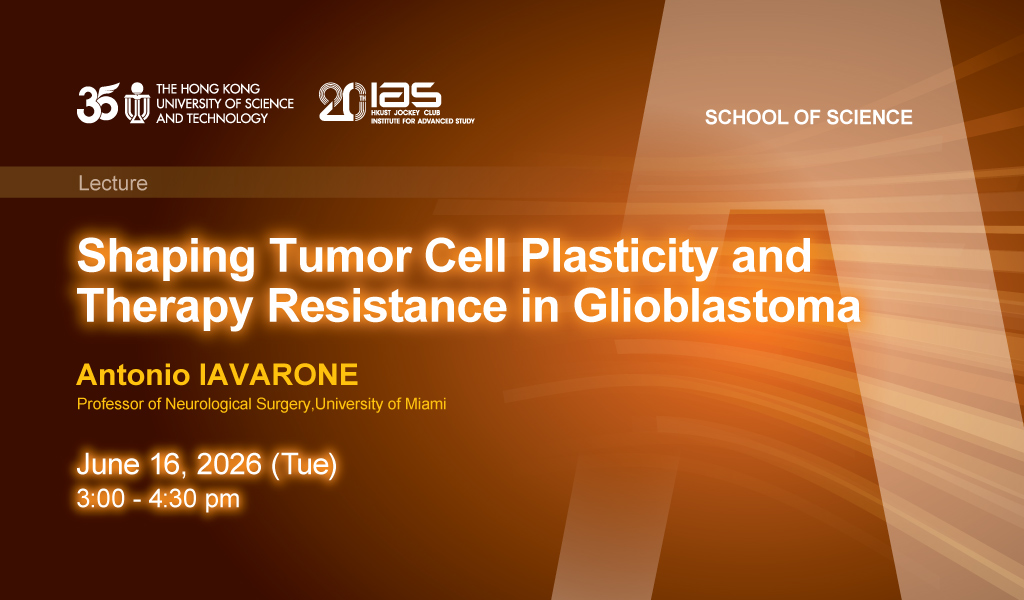
IAS / School of Science Joint Lecture - Shaping Tumor Cell Plasticity and Therapy Resistance in Glioblastoma
Abstract
Tumor heterogeneity fueled by plasticity and genetic diversification of cancer cells is key to therapy failure of malignant glioma. The speaker's team implemented spatial and genetic p...
5月11日
研討會, 演講, 講座
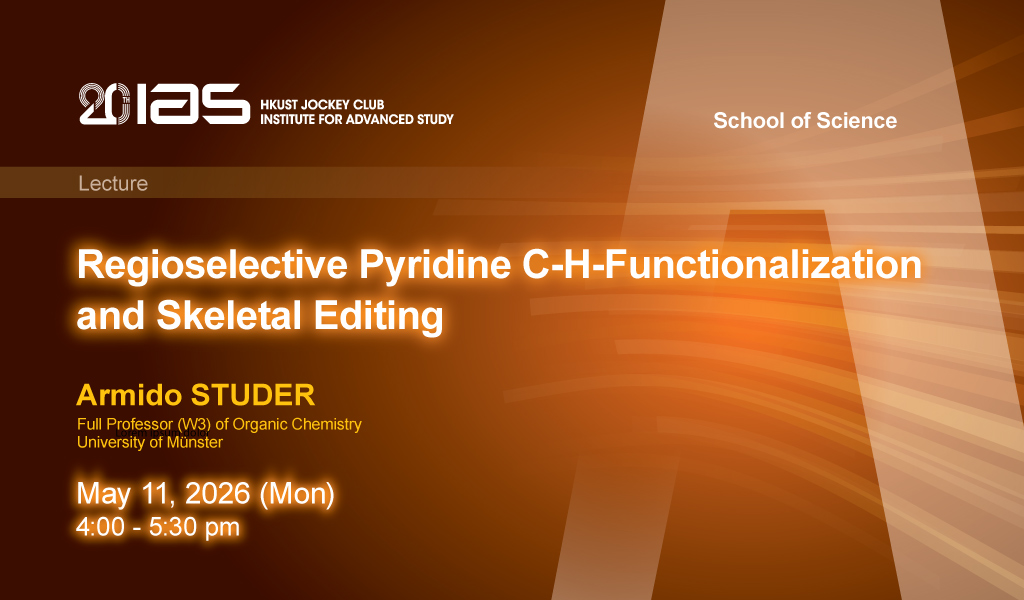
IAS / School of Science Joint Lecture - Regioselective Pyridine C-H-Functionalization and Skeletal Editing
Abstract
Pyridines belong to the most abundant heteroarenes in medicinal chemistry and in agrochemical industry. In the lecture, highly regioselective pyridine C-H functionalization through a d...