更多科大概覽

10月22日
9:00am - 10:00am
研討會, 演講, 講座

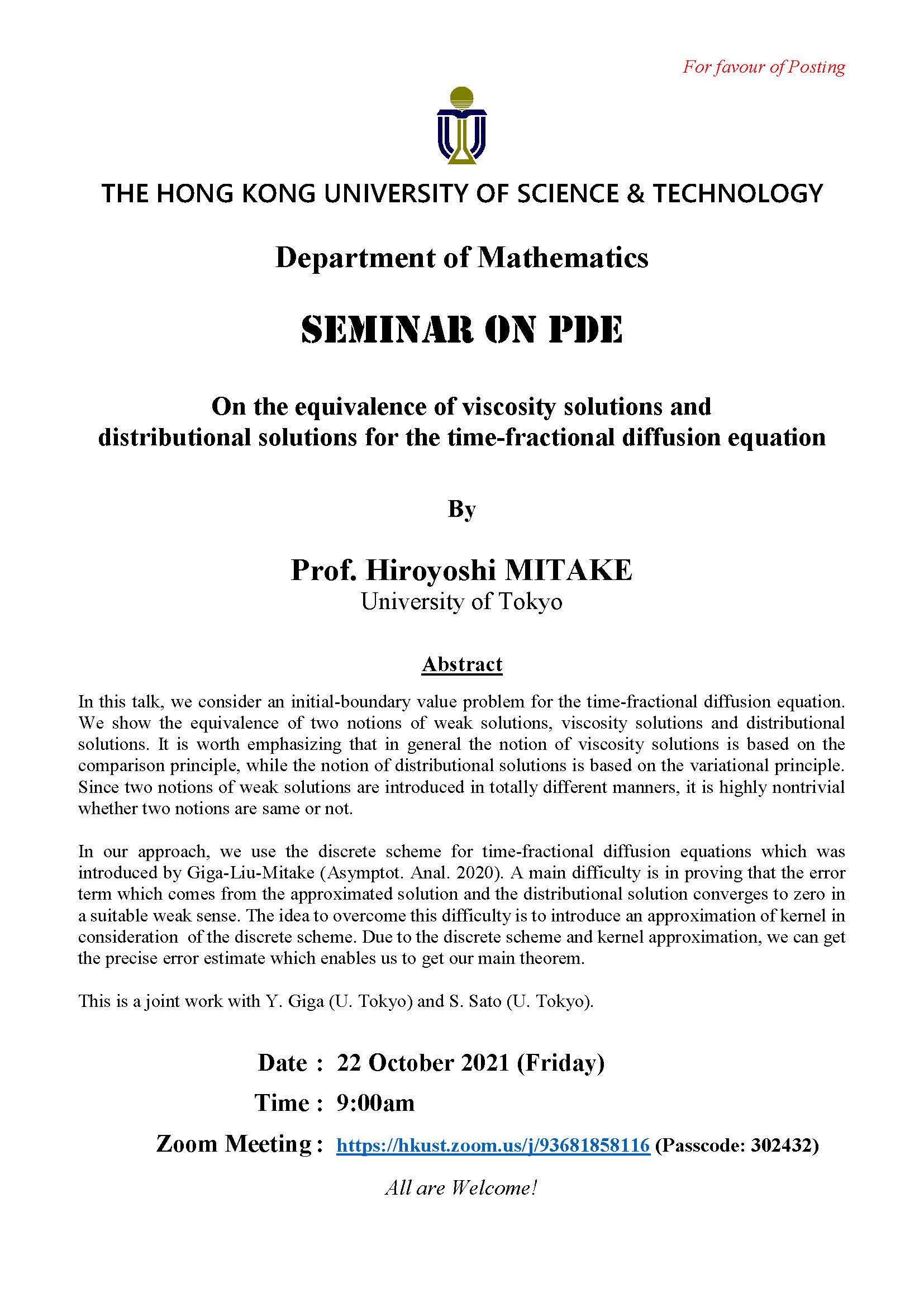
In this talk, we consider an initial-boundary value problem for the time-fractional diffusion equation. We show the equivalence of two notions of weak solutions, viscosity solutions and distributional solutions. It is worth emphasizing that in general the notion of viscosity solutions is based on the comparison principle, while the notion of distributional solutions is based on the variational principle. Since two notions of weak solutions are introduced in totally different manners, it is highly nontrivial whether two notions are same or not.
In our approach, we use the discrete scheme for time-fractional diffusion equations which was introduced by Giga-Liu-Mitake (Asymptot. Anal. 2020). A main difficulty is in proving that the error term which comes from the approximated solution and the distributional solution converges to zero in a suitable weak sense. The idea to overcome this difficulty is to introduce an approximation of kernel in consideration of the discrete scheme. Due to the discrete scheme and kernel approximation, we can get the precise error estimate which enables us to get our main theorem.
This is a joint work with Y. Giga (U. Tokyo) and S. Sato (U. Tokyo).
10月22日
9:00am - 10:00am

地點
https://hkust.zoom.us/j/93681858116 (Passcode: 302432)
講者/表演者
Prof. Hiroyoshi MITAKE
University of Tokyo
University of Tokyo
主辦單位
Department of Mathematics
聯絡方法
付款詳情
對象
Alumni, Faculty and staff, PG students, UG students
語言
英語
其他活動
6月16日
研討會, 演講, 講座
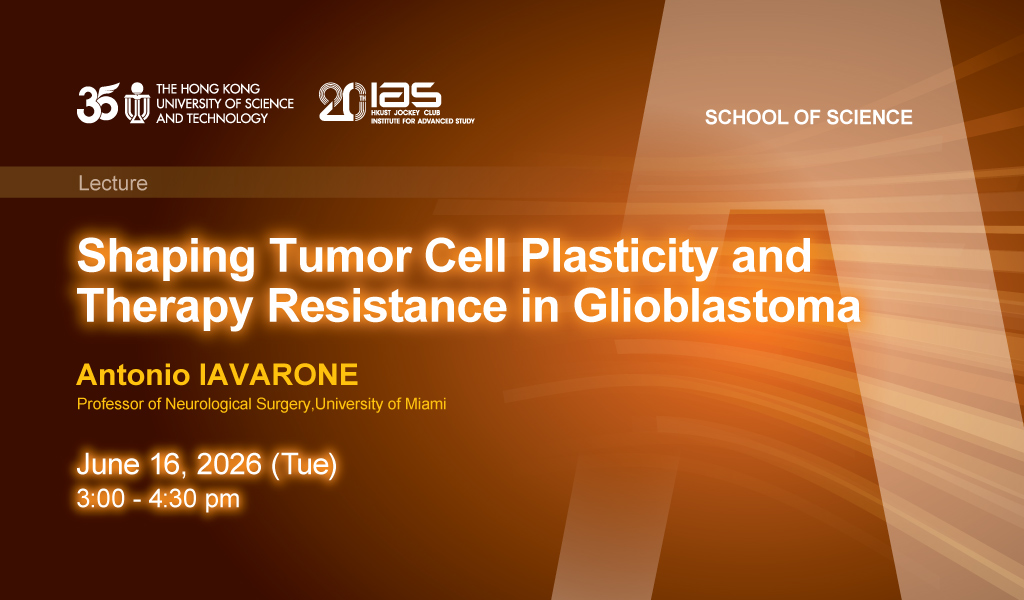
IAS / School of Science Joint Lecture - Shaping Tumor Cell Plasticity and Therapy Resistance in Glioblastoma
Abstract
Tumor heterogeneity fueled by plasticity and genetic diversification of cancer cells is key to therapy failure of malignant glioma. The speaker's team implemented spatial and genetic p...
5月11日
研討會, 演講, 講座
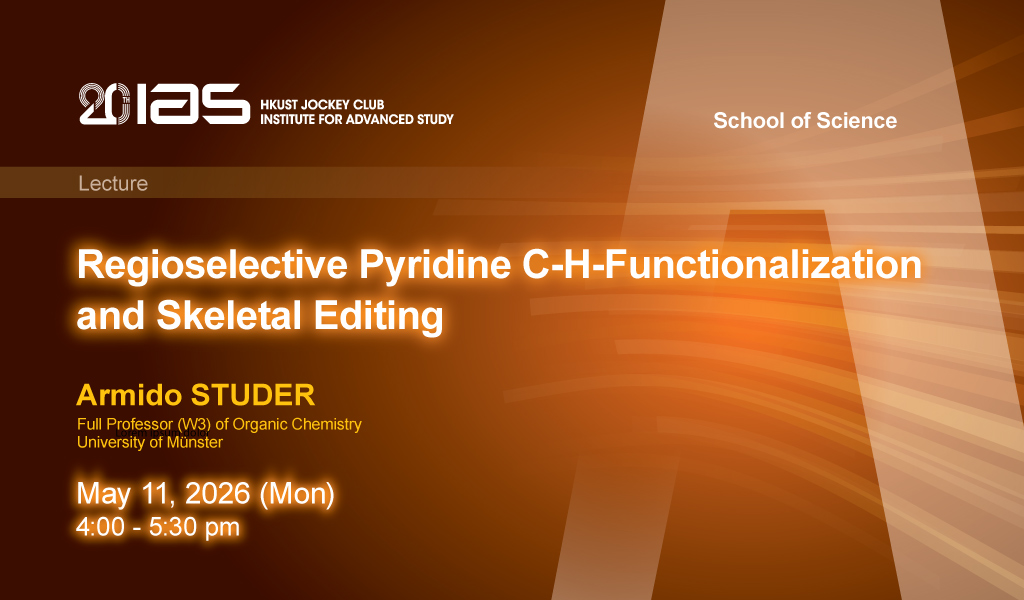
IAS / School of Science Joint Lecture - Regioselective Pyridine C-H-Functionalization and Skeletal Editing
Abstract
Pyridines belong to the most abundant heteroarenes in medicinal chemistry and in agrochemical industry. In the lecture, highly regioselective pyridine C-H functionalization through a d...