更多科大概覽

6月23日
3:00pm - 4:00pm
研討會, 演講, 講座

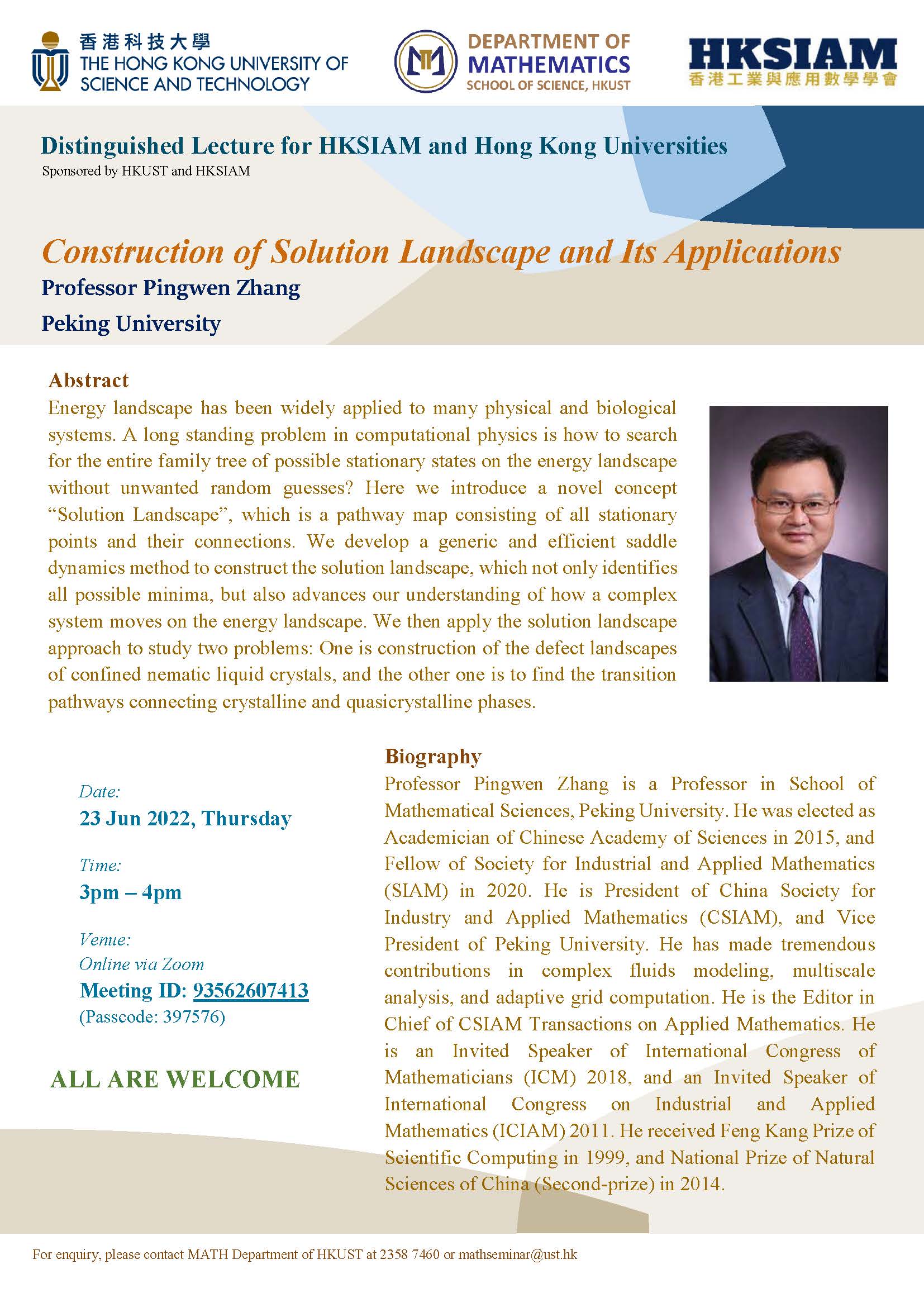
Energy landscape has been widely applied to many physical and biological systems. A long standing problem in computational physics is how to search for the entire family tree of possible stationary states on the energy landscape without unwanted random guesses? Here we introduce a novel concept “Solution Landscape”, which is a pathway map consisting of all stationary points and their connections. We develop a generic and efficient saddle dynamics method to construct the solution landscape, which not only identifies all possible minima, but also advances our understanding of how a complex system moves on the energy landscape. We then apply the solution landscape approach to study two problems: One is construction of the defect landscapes of confined nematic liquid crystals, and the other one is to find the transition pathways connecting crystalline and quasicrystalline phases.
6月23日
3:00pm - 4:00pm

地點
Meeting ID: 93562607413 (Passcode: 397576)
講者/表演者
Professor Pingwen ZHANG
Peking University
Peking University
主辦單位
Department of Mathematics
聯絡方法
付款詳情
對象
Alumni, Faculty and staff, PG students, UG students
語言
英語
其他活動
6月16日
研討會, 演講, 講座
IAS / School of Science Joint Lecture - Shaping Tumor Cell Plasticity and Therapy Resistance in Glioblastoma
Abstract
Tumor heterogeneity fueled by plasticity and genetic diversification of cancer cells is key to therapy failure of malignant glioma. The speaker's team implemented spatial and genetic p...
5月11日
研討會, 演講, 講座
IAS / School of Science Joint Lecture - Regioselective Pyridine C-H-Functionalization and Skeletal Editing
Abstract
Pyridines belong to the most abundant heteroarenes in medicinal chemistry and in agrochemical industry. In the lecture, highly regioselective pyridine C-H functionalization through a d...