更多科大概覽


5月31日
4:00pm - 5:00pm
研討會, 演講, 講座

In this presentation, we present a fourth-order conservative semi-Lagrangian (SL) finite vol-ume (FV) weighted essentially non-oscillatory (WENO) scheme without operator splitting for two-dimensional linear transport equations with applications of kinetic models including the nonlinear Vlasov-Poisson system, the guiding center Vlasov model and the incompressible Euler equation in the vorticity-stream function formulation. To achieve fourth-order accuracy in space, two main ingredients are proposed in the SL FV formulation. Firstly, we introduce a so-called cubic-curved quadrilateral upstream cell and applying an efficient clipping method to evaluate integrals on upstream cells. Secondly, we construct a new WENO reconstruction operator, which recovers a P3 polynomial from neighboring cell averages. Mass conservation is accomplished with the mass conservative nature of the reconstruction operator and the SL formulation. A positivity-preserving limiter is applied to maintain the positivity of the numerical solution wherever appropriate. For nonlinear kinetic models, the SL scheme is coupled with a fourth-order Runge-Kutta exponential integrator for high-order temporal accuracy. Extensive bench marks are tested to verify the designed properties.
5月31日
4:00pm - 5:00pm

地點
Room 5510 (Lifts 25/26)
講者/表演者
Prof. Jianxian QIU
School of Mathematical Sciences and Fujian Provincial Key Laboratory of Mathematical Modeling and High-Performance Scientific Computing, Xiamen University
School of Mathematical Sciences and Fujian Provincial Key Laboratory of Mathematical Modeling and High-Performance Scientific Computing, Xiamen University
主辦單位
Department of Mathematics
聯絡方法
付款詳情
對象
Alumni, Faculty and staff, PG students, UG students
語言
英語
其他活動
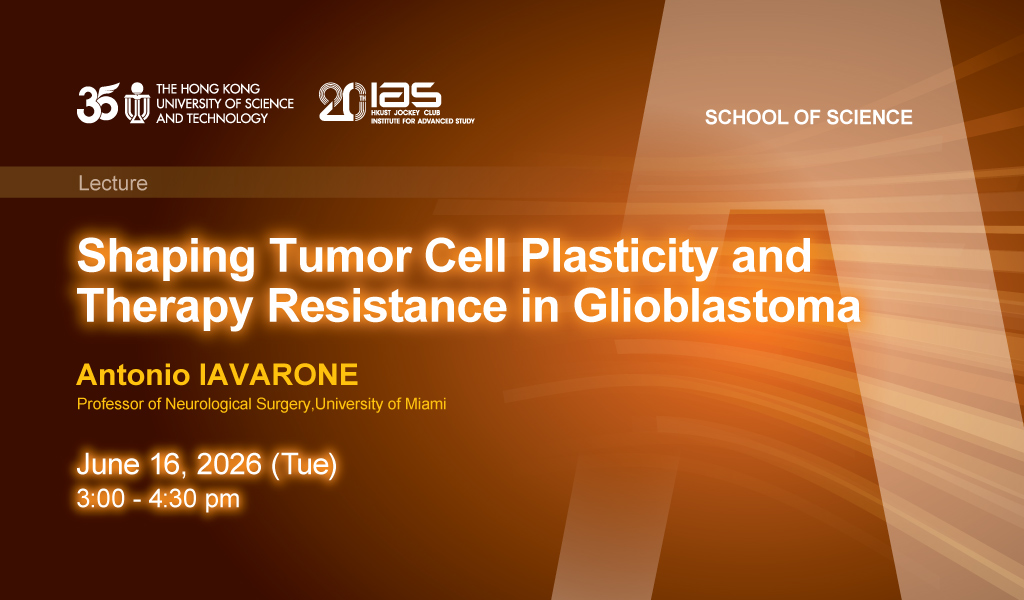
6月16日
研討會, 演講, 講座
IAS / School of Science Joint Lecture - Shaping Tumor Cell Plasticity and Therapy Resistance in Glioblastoma
Abstract
Tumor heterogeneity fueled by plasticity and genetic diversification of cancer cells is key to therapy failure of malignant glioma. The speaker's team implemented spatial and genetic p...
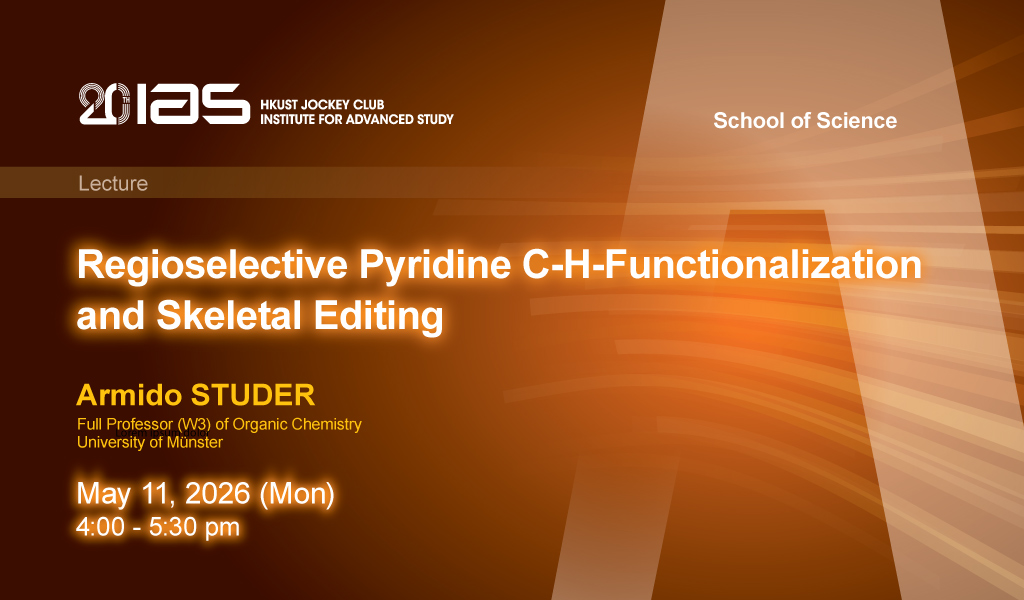
5月11日
研討會, 演講, 講座
IAS / School of Science Joint Lecture - Regioselective Pyridine C-H-Functionalization and Skeletal Editing
Abstract
Pyridines belong to the most abundant heteroarenes in medicinal chemistry and in agrochemical industry. In the lecture, highly regioselective pyridine C-H functionalization through a d...