歡迎

啟發可持續的科研革新文化。

突破科研界限,追求新發現及建立嶄新的研究模式。

關於理學院
理學院致力發展最尖端的科研項目,力求取得突破性的研究成果,建立最新的科研典範。
在教學方面,全面而高質素的課程特別著重培養學生的恒毅力、好奇心和創意…
理學院致力營造一個富活力的學習環境,並著重學術成就、創新及合作。
王殷厚
理學院院長
活動
研討會, 演講, 講座 | 2026年11月06日
IAS/ School of Science Joint Lecture - Drag on a Penetrable Disk in a Superfluid
Abstract The motion of a body through a superfluid can generate phenomena distinct from a normal viscous fluid. This includes the absence of drag below a critical body speed with the shedding of quantized vortices and non-zero drag above this speed. In this talk, the speaker will investigate the drag experienced by a penetrable circular disk that is moving in a superfluid described by the Gross-Pitaevksii equation. Using analytical theory and numerical simulations, he will show that the drag varies non-monotonically with the disk velocity, leading to complex dynamical behavior. These results advance understanding of the motion of bodies with finite penetrability, which is relevant to laser experiments probing the superfluidity of Bose-Einstein condensates.  About the Speaker Prof. John E. SADER gained his PhD from the University of New South Wales in Electrical Engineering and then joined the University of Melbourne in 1992 as a Research Fellow, progressing to Professor of Applied Mathematics before moving to the California Institute of Technology in 2022 as a Research Professor of Aerospace and Applied Physics. In 2026, he was also appointed Program Director for Research in the Physical Sciences at the W. M. Keck Foundation. Prof. Sader is an applied mathematician with over 30 years of experience in collaborative research that have focused on a broad range of areas, including fluid and solid mechanics, colloid science, plasmonics, and advanced scientific instrumentation. He is perhaps best known for developing experimental techniques that are widely used in atomic force microscopy, including the Sader Method which is implemented in commercial instruments. He is elected to Fellow of the American Physical Society, the Australian Academy of Science, the Australian Mathematical Society, and the Australasian Fluid Mechanics Society. For Attendees' Attention Seating is on a first come, first served basis.
研討會, 演講, 講座 | 2026年06月16日
IAS / School of Science Joint Lecture - Shaping Tumor Cell Plasticity and Therapy Resistance in Glioblastoma
Abstract Tumor heterogeneity fueled by plasticity and genetic diversification of cancer cells is key to therapy failure of malignant glioma. The speaker's team implemented spatial and genetic platforms at single cell resolution to explore the trajectory of evolution of glioblastoma.  Using spatial analysis of whole glioblastoma sections, the team established a homotypic clustered cell identity paradigm whereby tumor cell state coherence was maximal in cells organized in homotypic clusters, whereas dispersed cells downregulated the original state, acquired alternative phenotypes and exhibited changes in the microenvironment, thus linking the process of plasticity to loss of the cell adhesion mechanisms that preserve the clustered spatial pattern of glioblastoma cells. The team also used single cell DNA-sequencing methods integrated with the single cell transcriptome of patient-matched primary-recurrent glioblastoma pairs to resolve the clonal substructure of untreated glioblastoma and determine the clonal evolution at recurrence driven by therapeutic resistance. The evolutionary trajectory of glioblastoma identified a bottleneck model as the predominant pattern of evolution and converged on the identification of a rare persister subclonal state in primary glioblastoma exhibiting distinct phenotypic hallmarks that evolves and diversifies to populate the recurrent tumor mass. The team used preclinical tumor models to trace the individual lineages associated with the persister subclones and experimentally illuminated the biological and metabolic activities of the persister cellular state in brain tumors. Persister glioblastoma cells in untreated tumors lacked spatial segregation and were independent predictors of timing to recurrence for glioblastoma patients. Thus, genetic and non-genetic co-evolution mechanisms forge the acquisition of plasticity and therapy resistance in glioblastoma.   About the Speaker Prof. Antonio IAVARONE is Professor of Neurological Surgery, the Deputy Director of the Sylvester Comprehensive Cancer Center and the Director of the Sylvester Brain Tumor Institute at the University of Miami where he leads a lab composed of experimental and computational biologists working alongside clinician-scientists. By focusing on pediatric and adult brain tumors, the Iavarone lab has dissected the genetic and non-genetic mechanisms marking initiation and progression of cancer from normal brain. Prof. Iavarone discovered FGFR–TACC gene fusions, the most frequent gene fusion across human tumors. He uncovered a fusion-linked metabolic program-increased mitochondrial respiration-that creates vulnerabilities, providing a mechanistic rationale for biomarker-driven therapeutic strategies and therapies for cancers. He established that brain tumors are maintained by discrete, regulatable cell states enforced by identifiable driver lesions and “master” regulatory programs. His early studies defined core principles of cell-cycle and lineage control relevant to oncogenesis, including ID proteins as retinoblastoma-linked effectors and mechanisms coupling cell-cycle exit to neuronal differentiation.  Prof. Iavarone brought systems-level approaches into neuro-oncology by defining transcriptional modules that initiate and sustain mesenchymal transformation, a key driver of aggressiveness and treatment failure. He led/co-led large-scale efforts integrating multi-omics into tumor taxonomies. His pathway-based glioblastoma classification uncovered a mitochondrial subtype with therapeutic liabilities, and network-based analyses nominated candidate master kinases and regulators supporting rational combination strategies. Complementing this, his work in NF1-associated glioma defined the molecular landscape of a clinically challenging population, enabling precision diagnostics and risk-informed management for sporadic and genetically predisposed cancer of the brain.   For Attendees' Attention Seating is on a first come, first served basis.
研討會, 演講, 講座 | 2026年05月11日
IAS / School of Science Joint Lecture - Regioselective Pyridine C-H-Functionalization and Skeletal Editing
Abstract Pyridines belong to the most abundant heteroarenes in medicinal chemistry and in agrochemical industry. In the lecture, highly regioselective pyridine C-H functionalization through a dearomatization/rearomatization sequence will be discussed. The dearomatized oxazino pyridines can be easily prepared on a large scale, and meta-functionalization becomes achievable through light-initiated radical alkylation and ionic transformations.1 As example, using such an approach meta-fluorinated pyridines are readily accessible.2 The same intermediates upon protonation to give the corresponding pyridinium salts also allow the highly regioselective radical Minisci para-alkylation.3,4 In addition, Cu-catalyzed meta-arylation5 and switchable radical para/meta-difluoromethylation6 through such intermediates will be presented. Radical meta-nitration7 and ionic meta-hydroxylation8 work equally well through such intermediates. Finally, it will be shown that this dearomatization concept is also applicable to pyridine skeletal editing.9 Further, it will be discussed that an alternative radical dearomatization process can be used for C to N mutation in indoles and benzofurans.10   References 1. Cao, H.; Cheng, Q.; Studer, A. Science 2022, 378, 779. For a review, see: Bhattacharya, D.; Haring, M.; Studer, A. Chimia 2025, 79, 476. 2. Haring, M.; Balanna, K.; Cheng, Q.; Lammert, J.; Studer, A. J. Am. Chem. Soc. 2024, 146, 30758 3. Cao, H.; Bhattacharya, D.; Cheng, Q., Studer, A. J. Am. Chem. Soc. 2023, 145, 15581. 4. Wang, Z.; Xu, P.; Studer, A. Org. Chem. Front. 2024, 11, 3849. 5. Guo, S.-M.; Xu, P.; Studer, A. Angew. Chem. Int. Ed. 2024, 63, e202405385. 6. Xu, P.; Wang, Z.; Guo, S.-M.; Studer, A. Nat. Commun. 2024, 15, 4121. 7. Balanna, K.; Studer, A. J. Am. Chem. Soc. 2025, 147, 7485. 8. Bhattacharya, D.; Studer, A. Angew. Chem. Int. Ed. 2025, 64, e202423512. 9. Cheng, Q.; Bhattacharya, D.; Haring, M.; Cao, H.; Mück-Lichtenfeld, C.; Studer, A. Nat. Chem. 2024, 16, 741. 10. Wang, Z.; Xu, P.; Guo, S.-M.; Daniliuc, C. G.; Studer, A. Nature 2025, 642, 92.   About the Speaker Prof. Armido STUDER received his Diploma in 1991 and his PhD in 1995 from ETH Zürich under the direction of Prof. Dieter SEEBACH. He completed postdoctoral studies at the University of Pittsburgh with Prof. Dennis P. CURRAN. In 1996, he started his independent career at the ETH Zürich. In 2000, he was appointed as Associate Professor of Organic Chemistry at the Philipps-University Marburg and in 2004 as Full Professor (C4) of Organic Chemistry at the Westfälische- Wilhelms-University Münster. Since 2009, he has held a Full Professor (W3) position in Organic Chemistry at the University of Münster and has served as the Director of its Institute of Organic Chemistry. Prof. Studer has been honored with a series of prestigious awards including the Gottfried Wilhelm Leibniz Prize (2026), the Adolf Von Baeyer Commemorative Medal (2025), the Paracelsus Prize of the Schweizerische Chemische Gesellschaft (2024), and the Arthur C. Cope Late Career Scholars Award (2024), among other notable recognitions. He has been elected as a member of the European Academy of Sciences, the Academia Europaea, and the German National Academy of Sciences, alongside his designation as a Fellow of The Royal Society of Chemistry.   For Attendees' Attention Seating is on a first come, first served basis.    
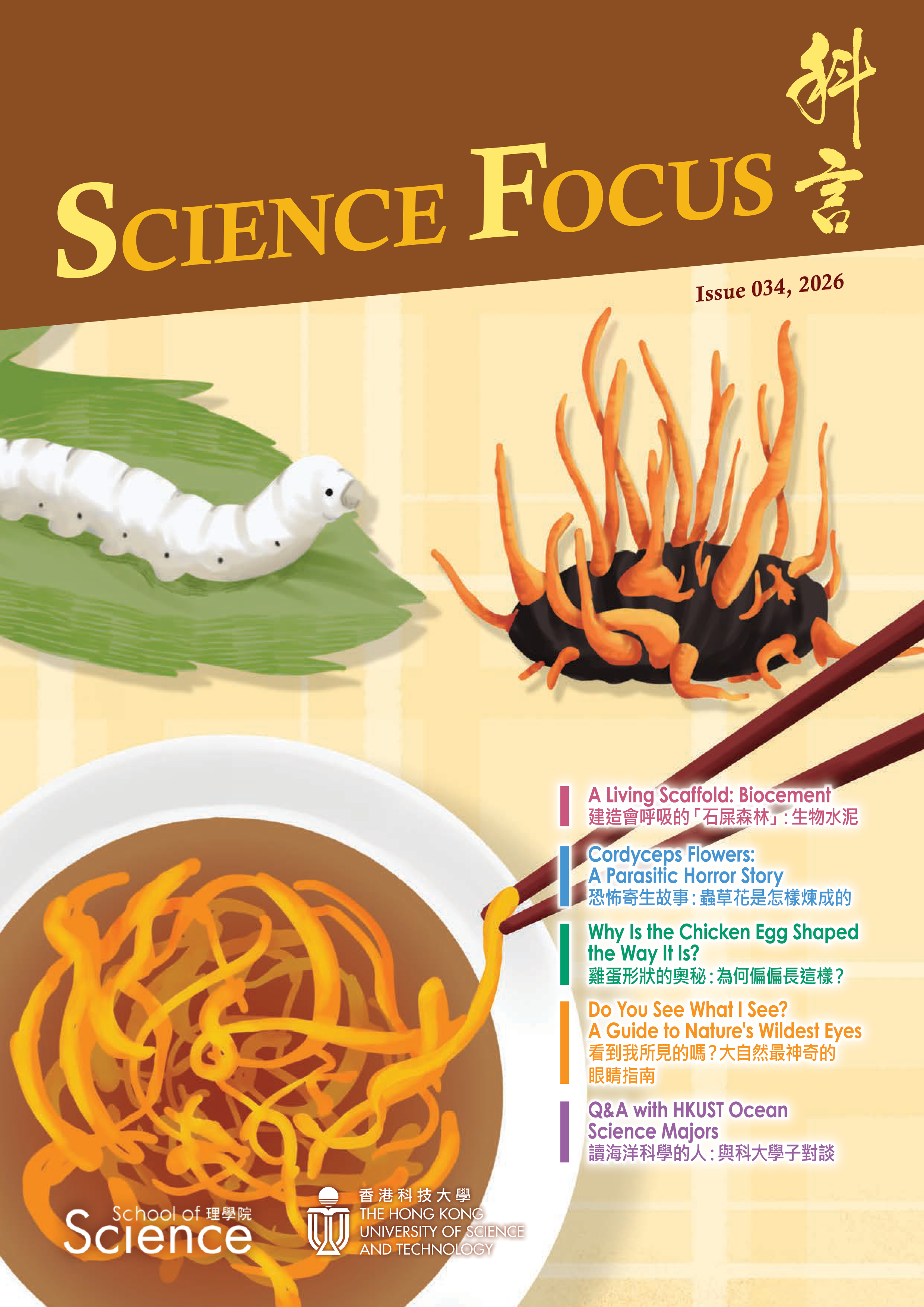
No. 34
Science Focus
Created by science UG students with faculty guidance, Science Focus aims at sparking students’ interest in science and scientific research through interesting articles.
InnoSci
InnoSci, the research newsletter of the School of Science, shares our faculty members' recent research discoveries and achievements, showcasing their novel ideas.
就讀
理學院
本科生
課程
注入新元素,使課程更加多樣化,並增加跨學科課程,培養學生獨立探索的能力。
研究生
課程
緊貼最新的科技發展,為學生提供具備啟發性思維的訓練。
學術單位
化學系
生命科學部
數學系
海洋科學系
物理系
化學系
化學系的教職員既充滿朝氣,亦具備群策群力的團隊精神。他們活躍於化學研究的各個領域,其研究成果更獲得國際認同。
生命科學部
生命科學部旨在促進生物科學的科研和教育之發展。
數學系
數學系的兩大基柱為追求卓越的研究成果及承諾提供高效優質的教學課程。
海洋科學系
本系旨在帶領各方認識不同領域的海洋科技,包括有關海洋保育,氣候變化,海洋資源管理,社會經濟及可持續發展的基礎概念和實踐。
物理系
物理系的使命乃由教學、科研及創新這鐵三角組成。
科目研究
突破科研界限,追求新發現及建立嶄新的研究模式。