更多科大概覽

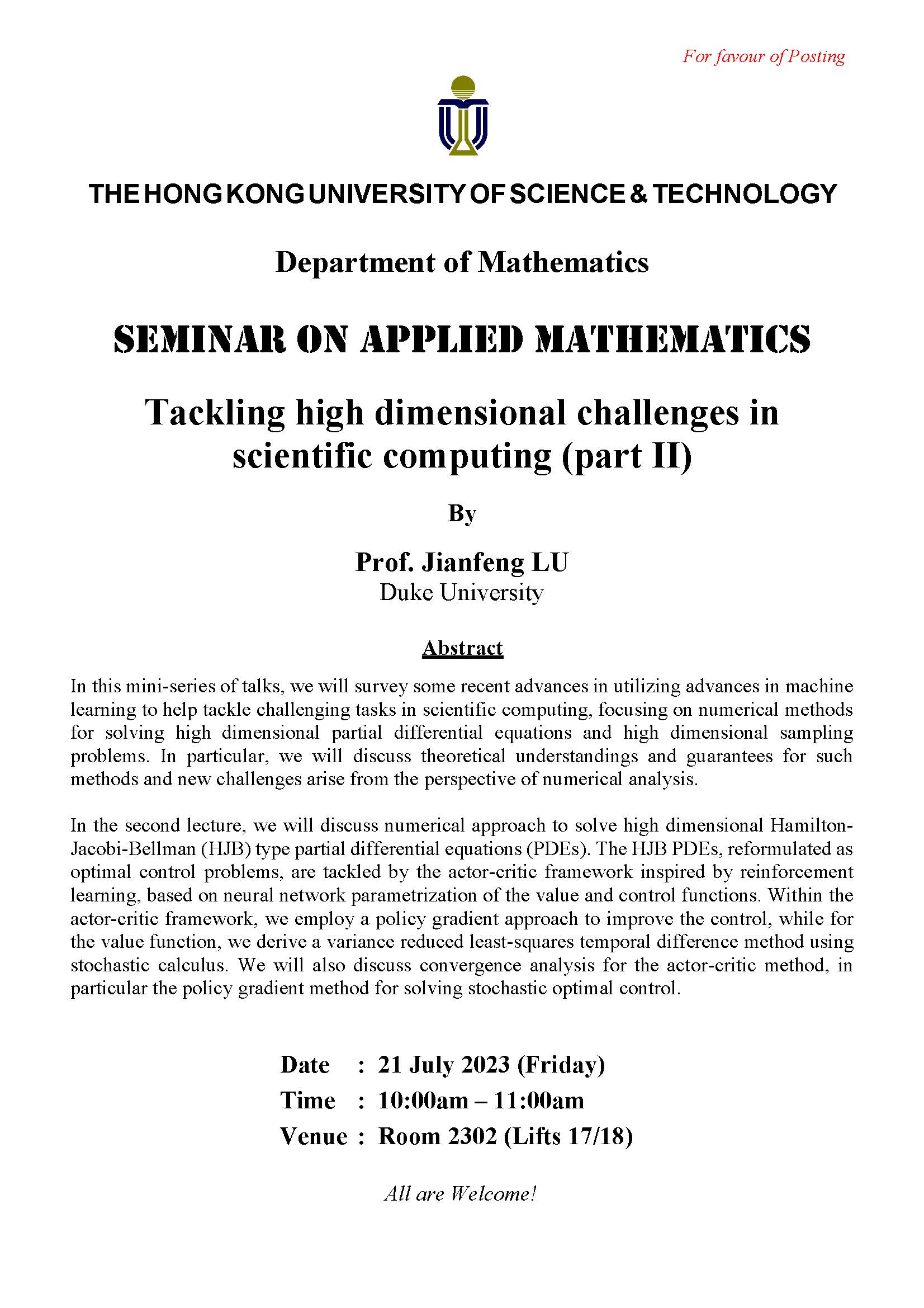
7月21日
10:00am - 11:00am
研討會, 演講, 講座

In this mini-series of talks, we will survey some recent advances in utilizing advances in machine learning to help tackle challenging tasks in scientific computing, focusing on numerical methods for solving high dimensional partial differential equations and high dimensional sampling problems. In particular, we will discuss theoretical understandings and guarantees for such methods and new challenges arise from the perspective of numerical analysis.
In the second lecture, we will discuss numerical approach to solve high dimensional Hamilton-Jacobi-Bellman (HJB) type partial differential equations (PDEs). The HJB PDEs, reformulated as optimal control problems, are tackled by the actor-critic framework inspired by reinforcement learning, based on neural network parametrization of the value and control functions. Within the actor-critic framework, we employ a policy gradient approach to improve the control, while for the value function, we derive a variance reduced least-squares temporal difference method using stochastic calculus. We will also discuss convergence analysis for the actor-critic method, in particular the policy gradient method for solving stochastic optimal control.
7月21日
10:00am - 11:00am

地點
Room 2302 (Lifts 17/18)
講者/表演者
Prof. Jianfeng LU
Duke University
Duke University
主辦單位
Department of Mathematics
聯絡方法
付款詳情
對象
Alumni, Faculty and staff, PG students, UG students
語言
英語
其他活動
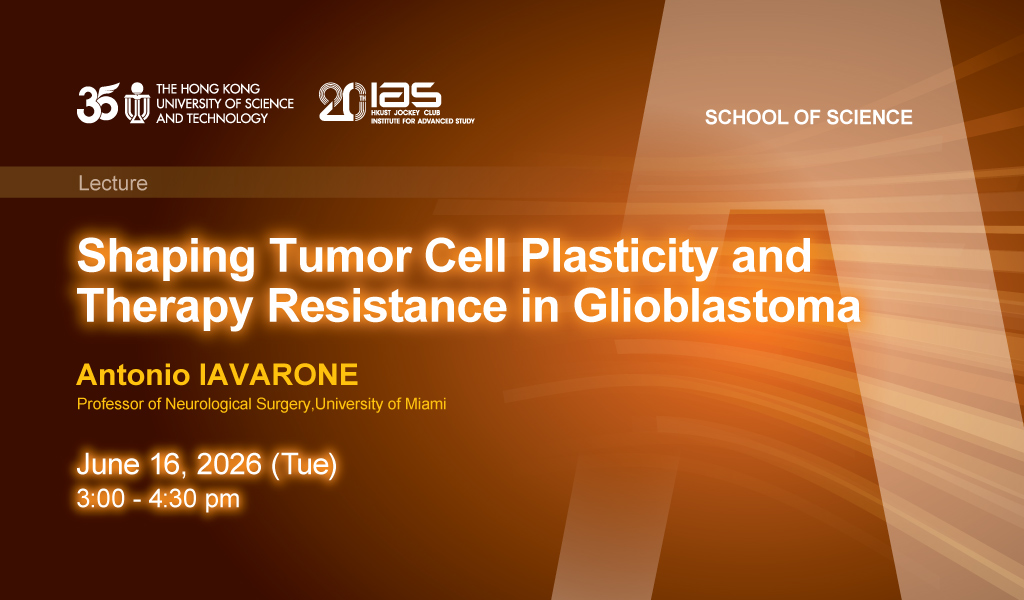
6月16日
研討會, 演講, 講座
IAS / School of Science Joint Lecture - Shaping Tumor Cell Plasticity and Therapy Resistance in Glioblastoma
Abstract
Tumor heterogeneity fueled by plasticity and genetic diversification of cancer cells is key to therapy failure of malignant glioma. The speaker's team implemented spatial and genetic p...
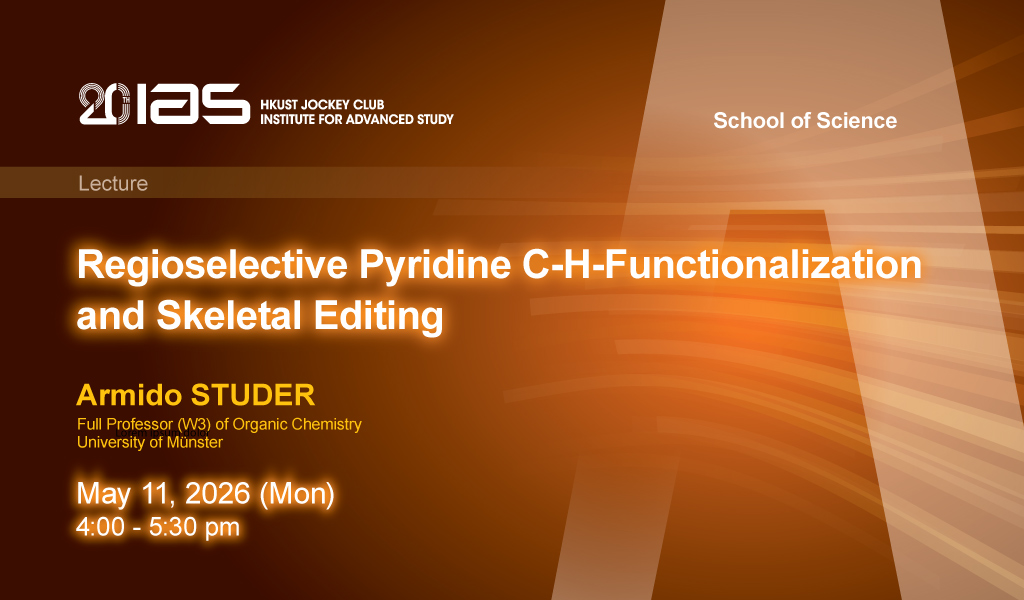
5月11日
研討會, 演講, 講座
IAS / School of Science Joint Lecture - Regioselective Pyridine C-H-Functionalization and Skeletal Editing
Abstract
Pyridines belong to the most abundant heteroarenes in medicinal chemistry and in agrochemical industry. In the lecture, highly regioselective pyridine C-H functionalization through a d...