更多科大概览


10月18日
3:00pm - 4:00pm
研讨会, 演讲, 讲座

Bernoulli percolation is a model for random media introduced by Broadbent and Hammersley in 1957. In this process, each vertex of a given graph is occupied or vacant, with respective probabilities p and 1-p, independently of the other vertices (for some parameter p). It is arguably one of the simplest models from statistical mechanics displaying a phase transition as the parameter p varies, i.e. a drastic change of behavior at some critical value p_c, and it has been widely studied.
Percolation can be used to analyze forest fire (or epidemics) processes. In such processes, all vertices of a lattice are initially vacant, and then become occupied at rate 1. If an occupied vertex is hit by lightning, which occurs at a (typically very small) rate, all the vertices connected to it burn immediately, i.e. they become vacant. In particular, we want to analyze the near-critical behavior of such processes, that is, when large components of occupied sites start to appear. They display a form of self-organized criticality, and the phase transition of Bernoulli percolation plays an important role: it appears "spontaneously".
This talk is based on a joint work with Rob van den Berg (CWI and VU, Amsterdam).
Percolation can be used to analyze forest fire (or epidemics) processes. In such processes, all vertices of a lattice are initially vacant, and then become occupied at rate 1. If an occupied vertex is hit by lightning, which occurs at a (typically very small) rate, all the vertices connected to it burn immediately, i.e. they become vacant. In particular, we want to analyze the near-critical behavior of such processes, that is, when large components of occupied sites start to appear. They display a form of self-organized criticality, and the phase transition of Bernoulli percolation plays an important role: it appears "spontaneously".
This talk is based on a joint work with Rob van den Berg (CWI and VU, Amsterdam).
10月18日
3:00pm - 4:00pm

地点
Lecture Theater F, Academic Building, 1/F (Lifts 25 - 26)
讲者/表演者
Prof. Pierre Nolin
Department of Mathematics, City University of Hong Kong
Department of Mathematics, City University of Hong Kong
主办单位
Department of Mathematics
联系方法
mathseminar@ust.hk
付款详情
对象
Alumni, Faculty and Staff, PG Students, UG Students
语言
英语
其他活动
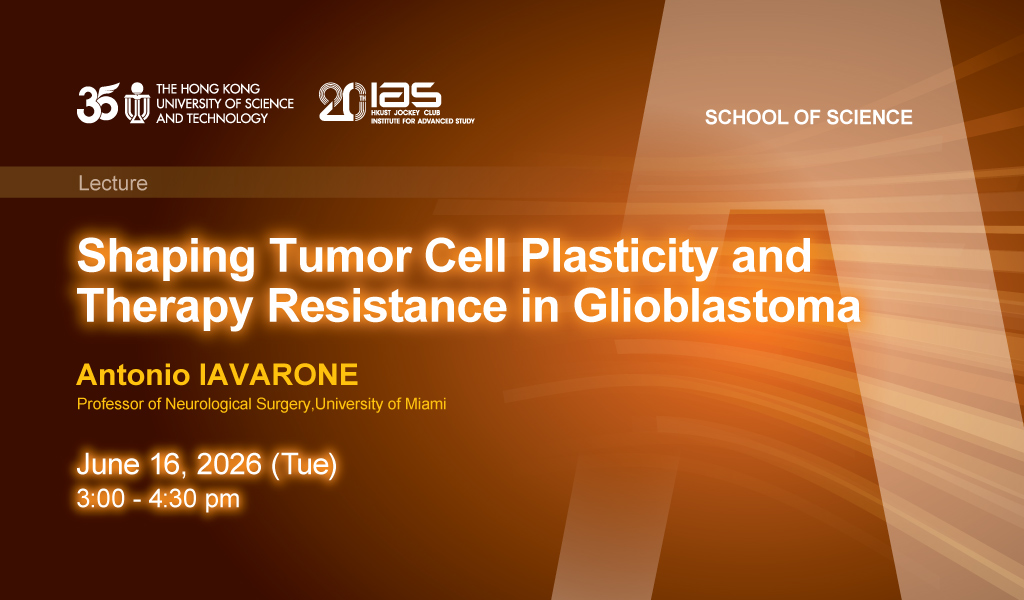
6月16日
研讨会, 演讲, 讲座
IAS / School of Science Joint Lecture - Shaping Tumor Cell Plasticity and Therapy Resistance in Glioblastoma
Abstract
Tumor heterogeneity fueled by plasticity and genetic diversification of cancer cells is key to therapy failure of malignant glioma. The speaker's team implemented spatial and genetic p...
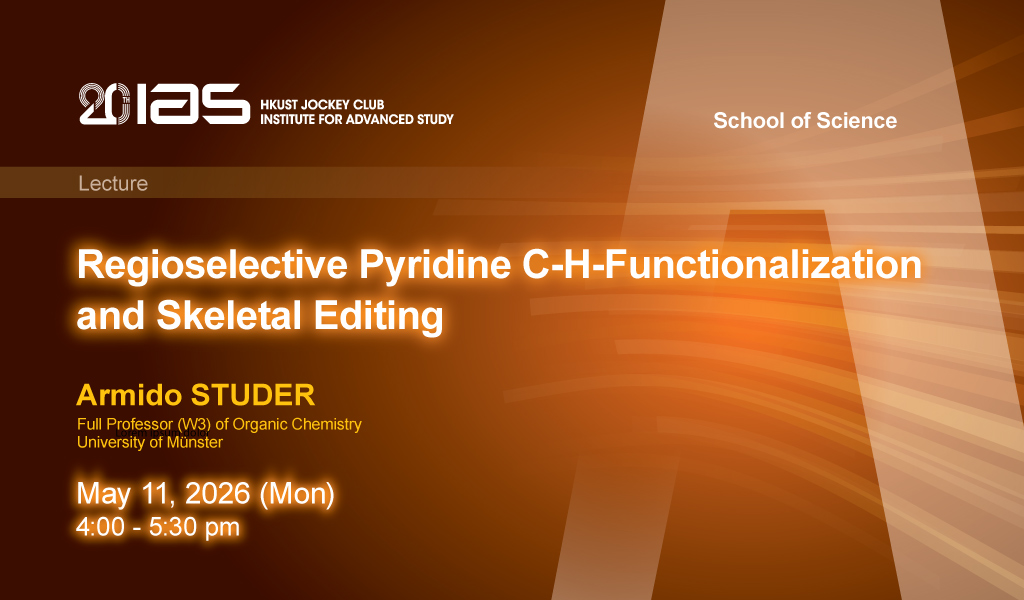
5月11日
研讨会, 演讲, 讲座
IAS / School of Science Joint Lecture - Regioselective Pyridine C-H-Functionalization and Skeletal Editing
Abstract
Pyridines belong to the most abundant heteroarenes in medicinal chemistry and in agrochemical industry. In the lecture, highly regioselective pyridine C-H functionalization through a d...