更多科大概覽

4月29日
9:30am - 10:30am
研討會, 演講, 講座

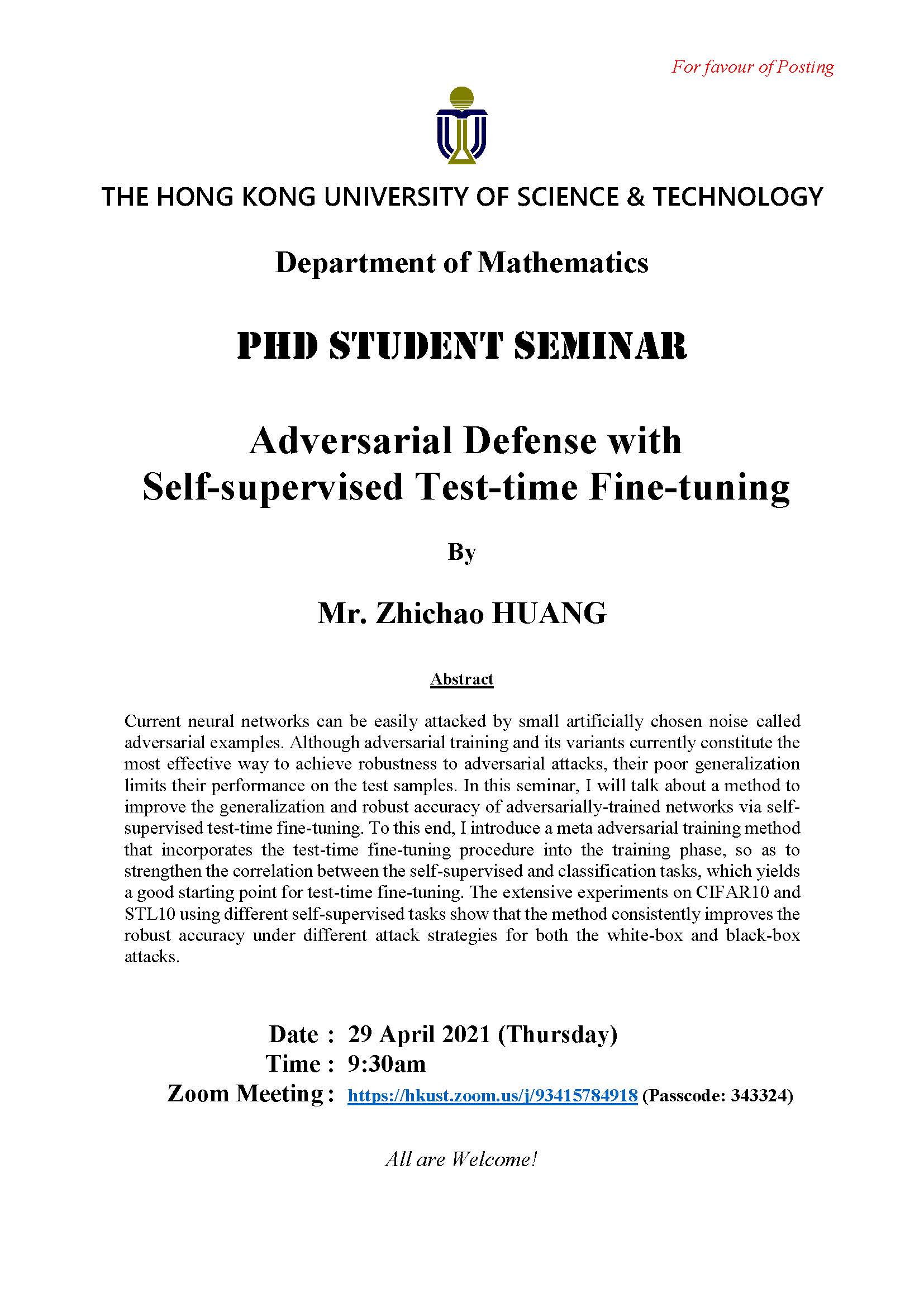
Current neural networks can be easily attacked by small artificially chosen noise called adversarial examples. Although adversarial training and its variants currently constitute the most effective way to achieve robustness to adversarial attacks, their poor generalization limits their performance on the test samples. In this seminar, I will talk about a method to improve the generalization and robust accuracy of adversarially-trained networks via self-supervised test-time fine-tuning. To this end, I introduce a meta adversarial training method that incorporates the test-time fine-tuning procedure into the training phase, so as to strengthen the correlation between the self-supervised and classification tasks, which yields a good starting point for test-time fine-tuning. The extensive experiments on CIFAR10 and STL10 using different self-supervised tasks show that the method consistently improves the robust accuracy under different attack strategies for both the white-box and black-box attacks.
4月29日
9:30am - 10:30am

地點
https://hkust.zoom.us/j/93415784918 (Passcode: 343324)
講者/表演者
Mr. Zhichao HUANG
主辦單位
Department of Mathematics
聯絡方法
付款詳情
對象
Alumni, Faculty and staff, PG students, UG students
語言
英語
其他活動
6月16日
研討會, 演講, 講座
IAS / School of Science Joint Lecture - Shaping Tumor Cell Plasticity and Therapy Resistance in Glioblastoma
Abstract
Tumor heterogeneity fueled by plasticity and genetic diversification of cancer cells is key to therapy failure of malignant glioma. The speaker's team implemented spatial and genetic p...
5月11日
研討會, 演講, 講座
IAS / School of Science Joint Lecture - Regioselective Pyridine C-H-Functionalization and Skeletal Editing
Abstract
Pyridines belong to the most abundant heteroarenes in medicinal chemistry and in agrochemical industry. In the lecture, highly regioselective pyridine C-H functionalization through a d...