更多科大概览

5月4日
11:30am - 12:30pm
研讨会, 演讲, 讲座

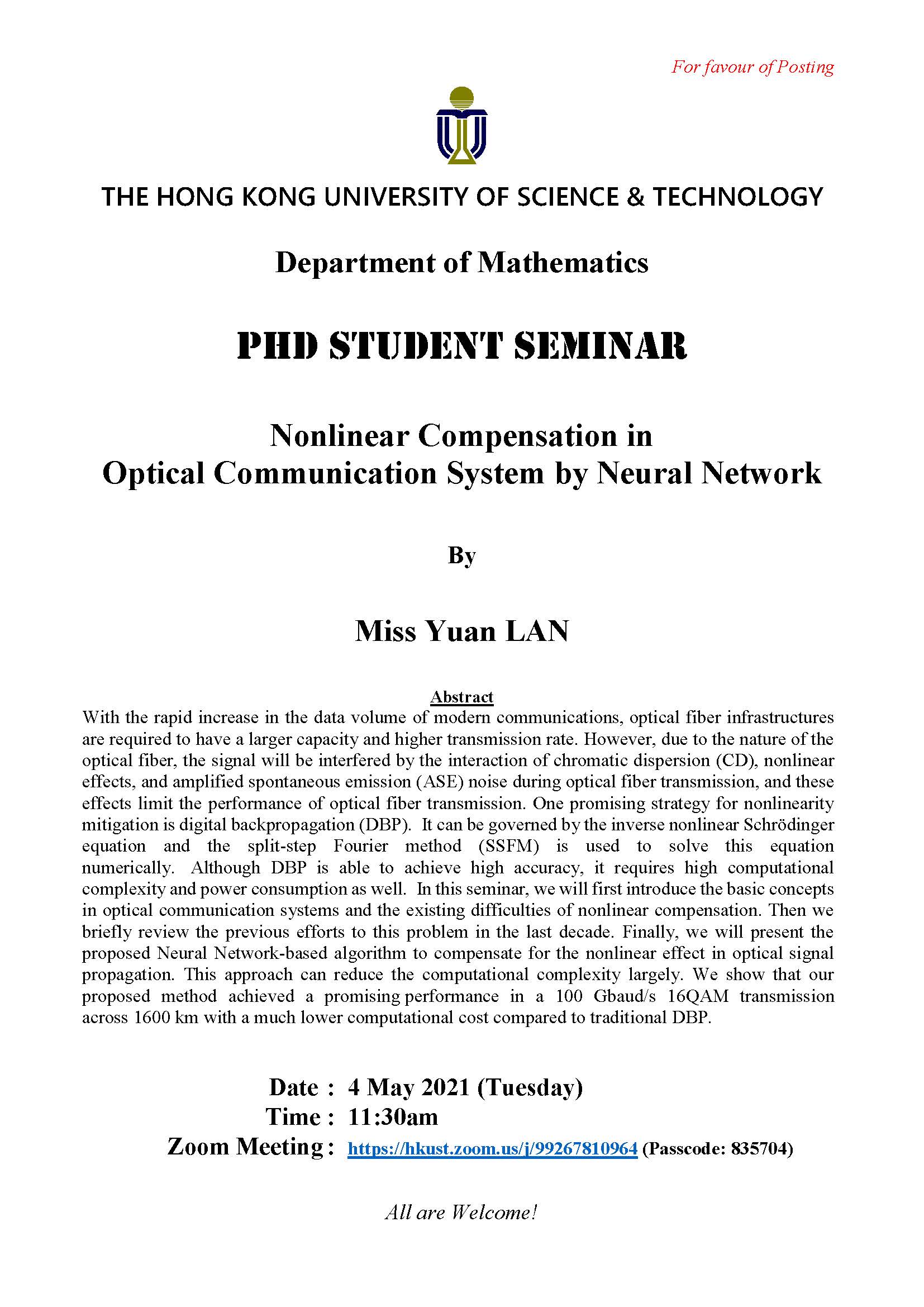
With the rapid increase in the data volume of modern communications, optical fiber infrastructures are required to have a larger capacity and higher transmission rate. However, due to the nature of the optical fiber, the signal will be interfered by the interaction of chromatic dispersion (CD), nonlinear effects, and amplified spontaneous emission (ASE) noise during optical fiber transmission, and these effects limit the performance of optical fiber transmission. One promising strategy for nonlinearity mitigation is digital backpropagation (DBP). It can be governed by the inverse nonlinear Schrödinger equation and the split-step Fourier method (SSFM) is used to solve this equation numerically. Although DBP is able to achieve high accuracy, it requires high computational complexity and power consumption as well. In this seminar, we will first introduce the basic concepts in optical communication systems and the existing difficulties of nonlinear compensation. Then we briefly review the previous efforts to this problem in the last decade. Finally, we will present the proposed Neural Network-based algorithm to compensate for the nonlinear effect in optical signal propagation. This approach can reduce the computational complexity largely. We show that our proposed method achieved a promising performance in a 100 Gbaud/s 16QAM transmission across 1600 km with a much lower computational cost compared to traditional DBP.
5月4日
11:30am - 12:30pm
地点
https://hkust.zoom.us/j/99267810964 (Passcode: 835704)
讲者/表演者
Miss Yuan LAN
主办单位
Department of Mathematics
联系方法
付款详情
对象
Alumni, Faculty and staff, PG students, UG students
语言
英语
其他活动
6月16日
研讨会, 演讲, 讲座
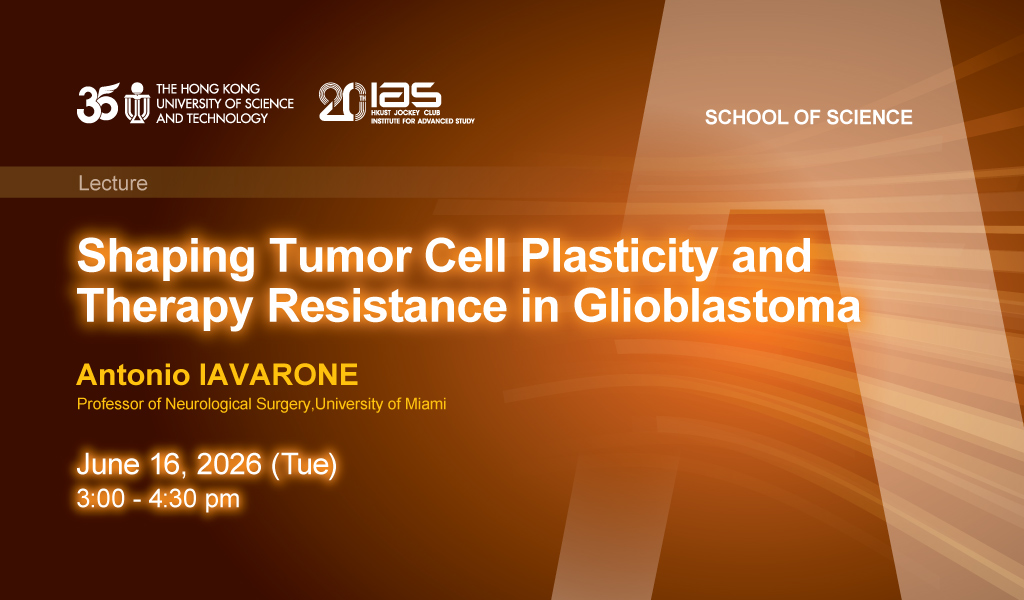
IAS / School of Science Joint Lecture - Shaping Tumor Cell Plasticity and Therapy Resistance in Glioblastoma
Abstract
Tumor heterogeneity fueled by plasticity and genetic diversification of cancer cells is key to therapy failure of malignant glioma. The speaker's team implemented spatial and genetic p...
5月11日
研讨会, 演讲, 讲座
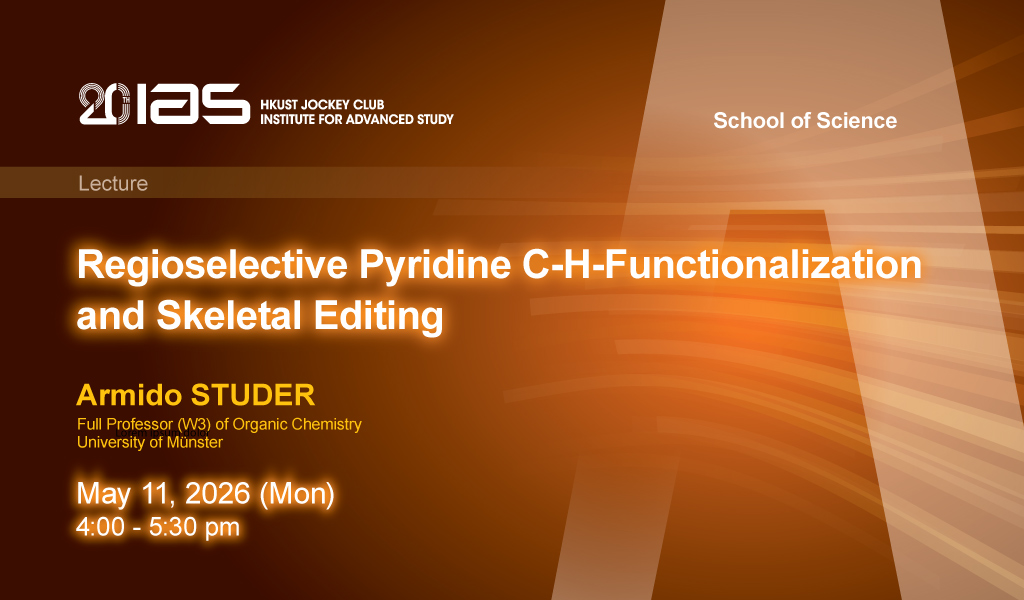
IAS / School of Science Joint Lecture - Regioselective Pyridine C-H-Functionalization and Skeletal Editing
Abstract
Pyridines belong to the most abundant heteroarenes in medicinal chemistry and in agrochemical industry. In the lecture, highly regioselective pyridine C-H functionalization through a d...