更多科大概览

8月6日
4:30pm - 5:30pm
研讨会, 演讲, 讲座

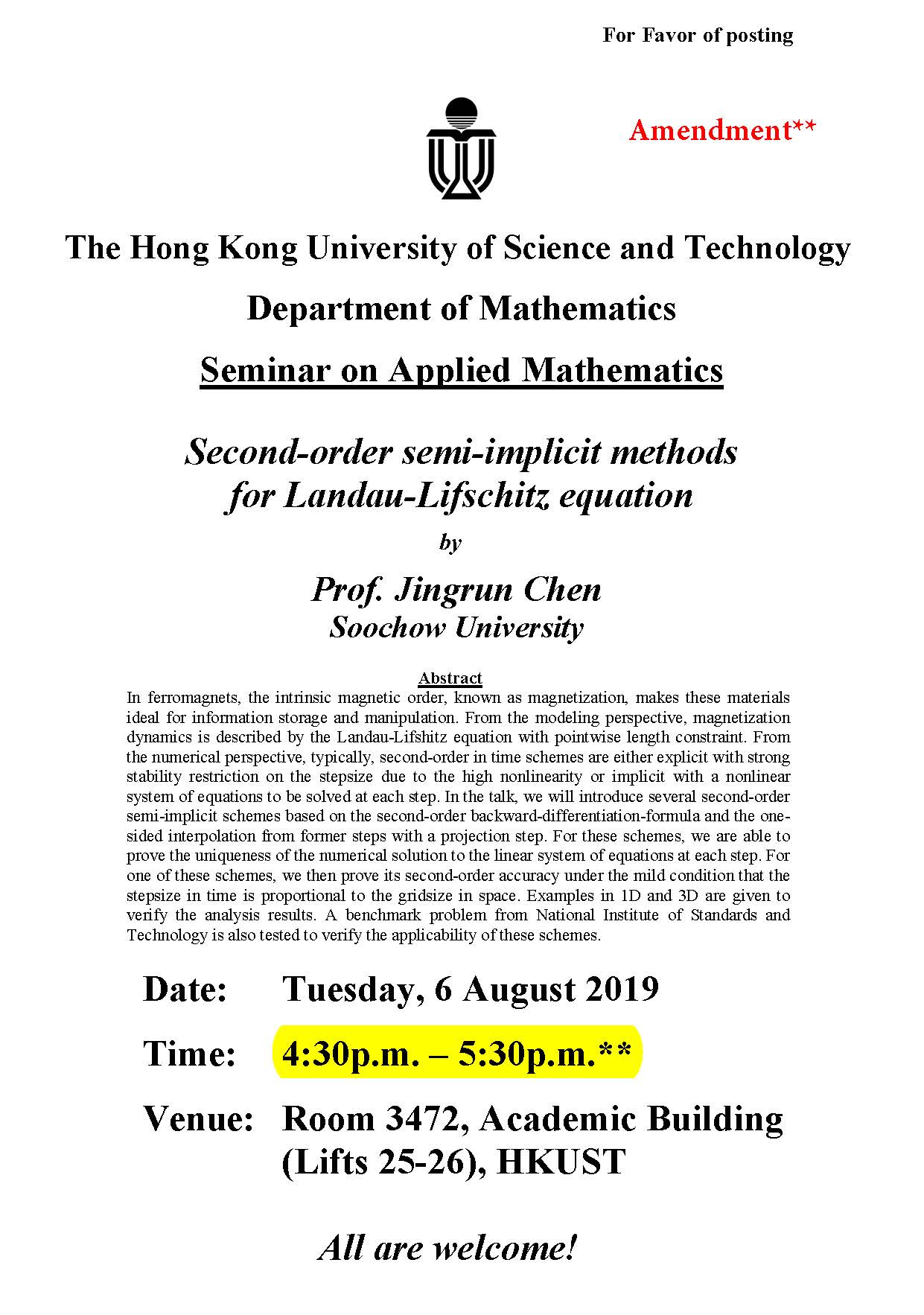
In ferromagnets, the intrinsic magnetic order, known as magnetization, makes these materials ideal for information storage and manipulation. From the modeling perspective, magnetization dynamics is described by the Landau-Lifshitz equation with pointwise length constraint. From the numerical perspective, typically, second-order in time schemes are either explicit with strong stability restriction on the stepsize due to the high nonlinearity or implicit with a nonlinear system of equations to be solved at each step. In the talk, we will introduce several second-order semi-implicit schemes based on the second-order backward-differentiation-formula and the one-sided interpolation from former steps with a projection step. For these schemes, we are able to prove the uniqueness of the numerical solution to the linear system of equations at each step. For one of these schemes, we then prove its second-order accuracy under the mild condition that the stepsize in time is proportional to the gridsize in space. Examples in 1D and 3D are given to verify the analysis results. A benchmark problem from National Institute of Standards and Technology is also tested to verify the applicability of these schemes.
8月6日
4:30pm - 5:30pm

地点
Room 3472, Academic Building (Lifts 25-26)
讲者/表演者
Prof. Jingrun Chen
Soochow University
Soochow University
主办单位
Department of Mathematics
联系方法
mathseminar@ust.hk
付款详情
对象
Alumni, Faculty and Staff, PG Students, UG Students
语言
英语
其他活动
6月16日
研讨会, 演讲, 讲座
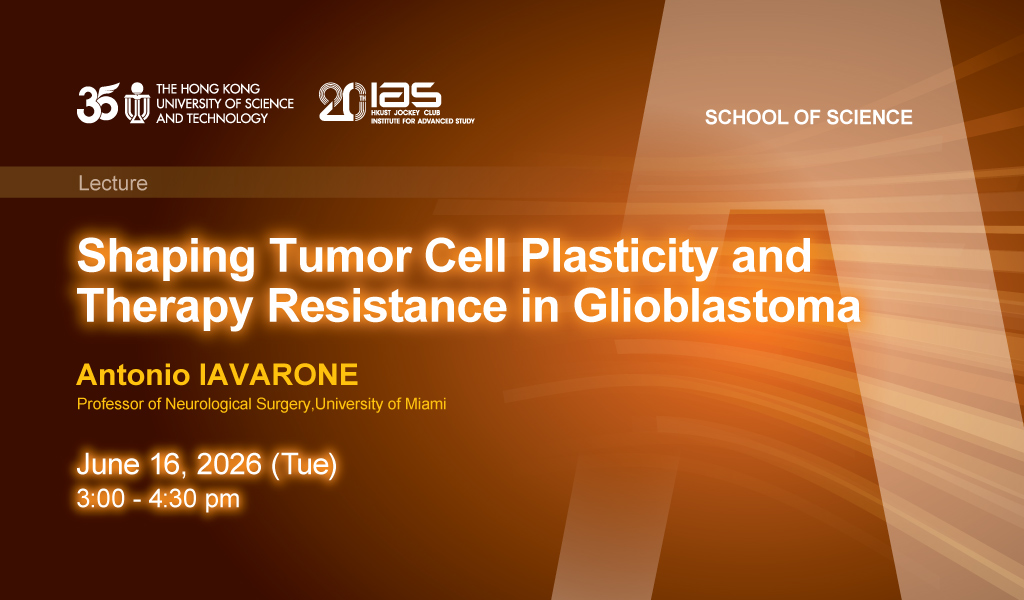
IAS / School of Science Joint Lecture - Shaping Tumor Cell Plasticity and Therapy Resistance in Glioblastoma
Abstract
Tumor heterogeneity fueled by plasticity and genetic diversification of cancer cells is key to therapy failure of malignant glioma. The speaker's team implemented spatial and genetic p...
5月11日
研讨会, 演讲, 讲座
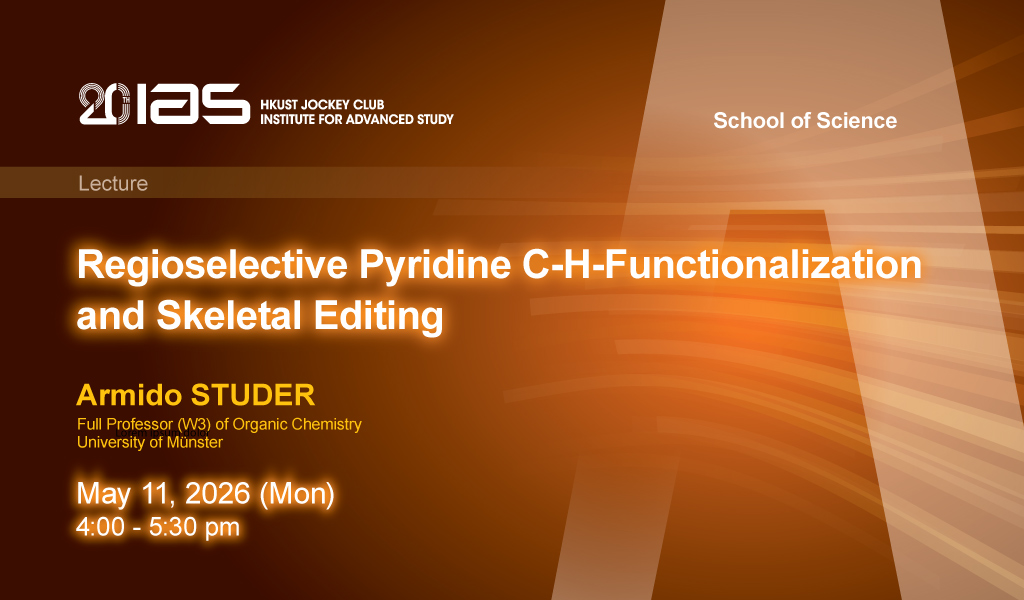
IAS / School of Science Joint Lecture - Regioselective Pyridine C-H-Functionalization and Skeletal Editing
Abstract
Pyridines belong to the most abundant heteroarenes in medicinal chemistry and in agrochemical industry. In the lecture, highly regioselective pyridine C-H functionalization through a d...