欢迎

启发可持续的科研革新文化。

突破科研界限,追求新发现及建立崭新的研究模式。

关于理学院
理学院致力发展最尖端的科研项目,力求取得突破性的研究成果,建立最新的科研典范。
在教学方面,全面而高质素的课程特别着重培养学生的恒毅力、好奇心和创意…
理学院致力营造一个富活力的学习环境,并着重学术成就、创新及合作。
王殷厚
理学院院长
活动
研讨会, 演讲, 讲座 | 2026年01月20日
IAS / School of Science Joint Lecture - A Journey to Defect Science and Engineering
  Abstract A defect in a material is one of the most important concerns when it comes to modifying and tuning the properties and phenomena of materials. The speaker will review his study of defects over the course of his professional career, reflecting on his journey through the history of this research as he prepares to retire from the university where he has worked for more than 30 years. The review will include the study of intrinsic and extrinsic defects since the defects can be introduced in various ways, either intrinsically or extrinsically.   The journey began with the study of ferroelectric oxides applied to non-volatile ferroelectric memories 35 years ago, when one of the reliabilities for the realization of ferroelectric memories was a critical issue. The defect intensively coined at the reliability issue was an oxygen vacancy, which is a fundamental and intrinsic defect. The oxygen deficiency inevitably occurs in oxides greatly affects fatigue and imprint reliability. The fatigue had been resolved by the use of oxide electrode, either doped layered perovskite ferroelectrics. The study on the oxygen vacancy defects continued on low d-electron occupancy perovskites among transition metal oxides and rare-earth fluorite oxides in the f-electron system. The first-principles calculations suggested that oxygen vacancies tended to cluster along a specific direction, i.e., 001 direction in SrTiO3, followed by experimental validation. Ferromagnetism evolved from heavily oxygen-deficient CeO2, known for its role as an oxygen reservoir. Oxygen vacancy engineering was also used to induce two-phase coexistence with different transition temperatures to mimic the two-phase coexistence during the first-order phase transition. From oxygen vacancy engineering, the isostructural metal-insulator transition of VO2 was predicted and validated while structural and electronic transitions were known to be coupled in the transition. Initiated by the oxygen vacancy clustering along the specific direction, the defect study was extended to the geometrical aspect of defect distribution and location at the atomic scale. The control of extrinsic defect distribution led to considering materials dimensionality in fractional number, whereas materials dimensionality used to be defined by integral number, i.e., 0, 1, 2, 3D. Theoretical and experimental studies revealed that the geometrical control of defect distribution (La doped SrTiO3), namely geometrical doping, led to a wide span of material states from a highly symmetric charge fluid to a charge disproportionated insulating state. Geometrical doping is added as another axis to the fundamental parameters of chemical doping, such as the amount and type of defect. The formation energy of oxygen vacancies was studied by machine learning (ML), since the oxygen vacancy is an intrinsic defect and the tendency of oxygen vacancy formation is an important concern from a material state to device performance. The formation energy of oxygen vacancies was predicted for more than 30,000 oxides available in the periodic table using an ensemble ML model, which is the last study of the defect in this journey at Sunkyunkwan University.   About the Speaker Prof. Jaichan LEE earned his PhD in Ceramic Science and Engineering from Rutgers University, USA, in 1993. He obtained his MS in Materials Science and Engineering from KAIST, Korea, in 1985, and his BS in Metallurgical Engineering from Seoul National University, Korea, in 1983. Prof. Lee is a Professor in the Department of Advanced Materials Science and Engineering at Sungkyunkwan University (SKKU) since 1995. From 1993 to 1994, he served as a Postdoctoral Member of Technical Staff at Bell Communications Research in the USA. Prior to his current role, he worked as a Member of Technical Staff at Samsung Advanced Institute of Technology from 1987 to 1989, and at Samsung Electro-Mechanics Co. from 1985 to 1987. Prof. Lee’s significant contributions to the field have been recognized through various awards and honors, including the Success Award in Engineering from SKKU in 2019, and serving as President of The Korean Dielectrics Society from 2019 to 2021. He has also chaired the Ferroelectrics/Dielectrics Symposium from 2007 to 2021 and the 10th and 11th Korea-Japan Conference on Ferroelectrics from 2012 to 2016.    For Attendees' Attention Seating is on a first come, first served basis.

研讨会, 演讲, 讲座 | 2026年01月20日
IAS / School of Science Joint Lecture - A Journey to Defect Science and Engineering
  Abstract A defect in a material is one of the most important concerns when it comes to modifying and tuning the properties and phenomena of materials. The speaker will review his study of defects over the course of his professional career, reflecting on his journey through the history of this research as he prepares to retire from the university where he has worked for more than 30 years. The review will include the study of intrinsic and extrinsic defects since the defects can be introduced in various ways, either intrinsically or extrinsically.   The journey began with the study of ferroelectric oxides applied to non-volatile ferroelectric memories 35 years ago, when one of the reliabilities for the realization of ferroelectric memories was a critical issue. The defect intensively coined at the reliability issue was an oxygen vacancy, which is a fundamental and intrinsic defect. The oxygen deficiency inevitably occurs in oxides greatly affects fatigue and imprint reliability. The fatigue had been resolved by the use of oxide electrode, either doped layered perovskite ferroelectrics. The study on the oxygen vacancy defects continued on low d-electron occupancy perovskites among transition metal oxides and rare-earth fluorite oxides in the f-electron system. The first-principles calculations suggested that oxygen vacancies tended to cluster along a specific direction, i.e., 001 direction in SrTiO3, followed by experimental validation. Ferromagnetism evolved from heavily oxygen-deficient CeO2, known for its role as an oxygen reservoir. Oxygen vacancy engineering was also used to induce two-phase coexistence with different transition temperatures to mimic the two-phase coexistence during the first-order phase transition. From oxygen vacancy engineering, the isostructural metal-insulator transition of VO2 was predicted and validated while structural and electronic transitions were known to be coupled in the transition. Initiated by the oxygen vacancy clustering along the specific direction, the defect study was extended to the geometrical aspect of defect distribution and location at the atomic scale. The control of extrinsic defect distribution led to considering materials dimensionality in fractional number, whereas materials dimensionality used to be defined by integral number, i.e., 0, 1, 2, 3D. Theoretical and experimental studies revealed that the geometrical control of defect distribution (La doped SrTiO3), namely geometrical doping, led to a wide span of material states from a highly symmetric charge fluid to a charge disproportionated insulating state. Geometrical doping is added as another axis to the fundamental parameters of chemical doping, such as the amount and type of defect. The formation energy of oxygen vacancies was studied by machine learning (ML), since the oxygen vacancy is an intrinsic defect and the tendency of oxygen vacancy formation is an important concern from a material state to device performance. The formation energy of oxygen vacancies was predicted for more than 30,000 oxides available in the periodic table using an ensemble ML model, which is the last study of the defect in this journey at Sunkyunkwan University.   About the Speaker Prof. Jaichan LEE earned his PhD in Ceramic Science and Engineering from Rutgers University, USA, in 1993. He obtained his MS in Materials Science and Engineering from KAIST, Korea, in 1985, and his BS in Metallurgical Engineering from Seoul National University, Korea, in 1983. Prof. Lee is a Professor in the Department of Advanced Materials Science and Engineering at Sungkyunkwan University (SKKU) since 1995. From 1993 to 1994, he served as a Postdoctoral Member of Technical Staff at Bell Communications Research in the USA. Prior to his current role, he worked as a Member of Technical Staff at Samsung Advanced Institute of Technology from 1987 to 1989, and at Samsung Electro-Mechanics Co. from 1985 to 1987. Prof. Lee’s significant contributions to the field have been recognized through various awards and honors, including the Success Award in Engineering from SKKU in 2019, and serving as President of The Korean Dielectrics Society from 2019 to 2021. He has also chaired the Ferroelectrics/Dielectrics Symposium from 2007 to 2021 and the 10th and 11th Korea-Japan Conference on Ferroelectrics from 2012 to 2016.    For Attendees' Attention Seating is on a first come, first served basis.
研讨会, 演讲, 讲座 | 2026年01月06日
IAS / School of Science Joint Lecture - Innovations in Organo Rare-Earth and Titanium Chemistry: From Self-Healing Polymers to N2 Activation
Abstract In this lecture, the speaker will introduce their recent studies on the development of innovative organometallic complexes and catalysts aimed at realizing unprecedented chemical transformations and advancing functional polymer synthesis. Representative achievements include the creation of novel self-healing polymers through sequence-controlled olefin copolymerization enabled by organo rare-earth catalysts; regio- and stereoselective C–H functionalization by tuning the ligand/metal combination of rare-earth catalysts; and the activation and functionalization of dinitrogen (N2) by well-defined multimetallic titanium hydride complexes. These studies highlight the pivotal role of catalyst design in modern chemical synthesis. Looking ahead, further exploring the potential of organometallic complexes and catalysts in a wide range of chemical transformations will continue to drive new advances in synthetic methodology and functional polymer synthesis, laying the foundation of next-generation technologies for a sustainable society.   About the Speaker Prof. HOU Zhaomin received his PhD from Kyushu University in 1989. After completing postdoctoral studies in RIKEN, Wako and the University of Windsor, he joined RIKEN as a Research Scientist in 1993. He is currently the Chief Scientist and Director of the Organometallic Chemistry Laboratory at the RIKEN Pioneering Research Institute, as well as the Group Director of the Advanced Catalysis Research Group and Deputy Director of the RIKEN Center for Sustainable Resource Science. Prof. Hou's research interests cover broad areas of organometallic chemistry, which include the synthesis of new organometallic complexes having novel structures, the development of more efficient, selective catalysts for olefin polymerization and organic synthesis, and the activation and efficient utilization of small molecules. He has been serving as an Executive Editor of Journal of the American Chemical Society since 2021. Prof. Hou's honors and awards include the Honorary Fellow of Chinese Chemical Society (2025), the Honorary Member of the Chemical Society of Japan (2023), the Japan Academy Prize (2022), the Chemical Society of Japan Award (2019), Swiss Chemical Society Lectureship Award (2018), the Chinese Chemical Society Yaozeng Huang Award in Organometallic Chemistry (2014), the Award of the Society of Polymer Science, Japan (2012), the Rare-Earth Society of Japan Award (2009), the Commendation for Science and Technology by the Minister of Education, Culture, Sports, Science and Technology, Japan (2008), the JSPS Prize (2007), and the Mitsui Chemicals Catalysis Science Award (2007).   For Attendees' Attention Seating is on a first come, first served basis.  
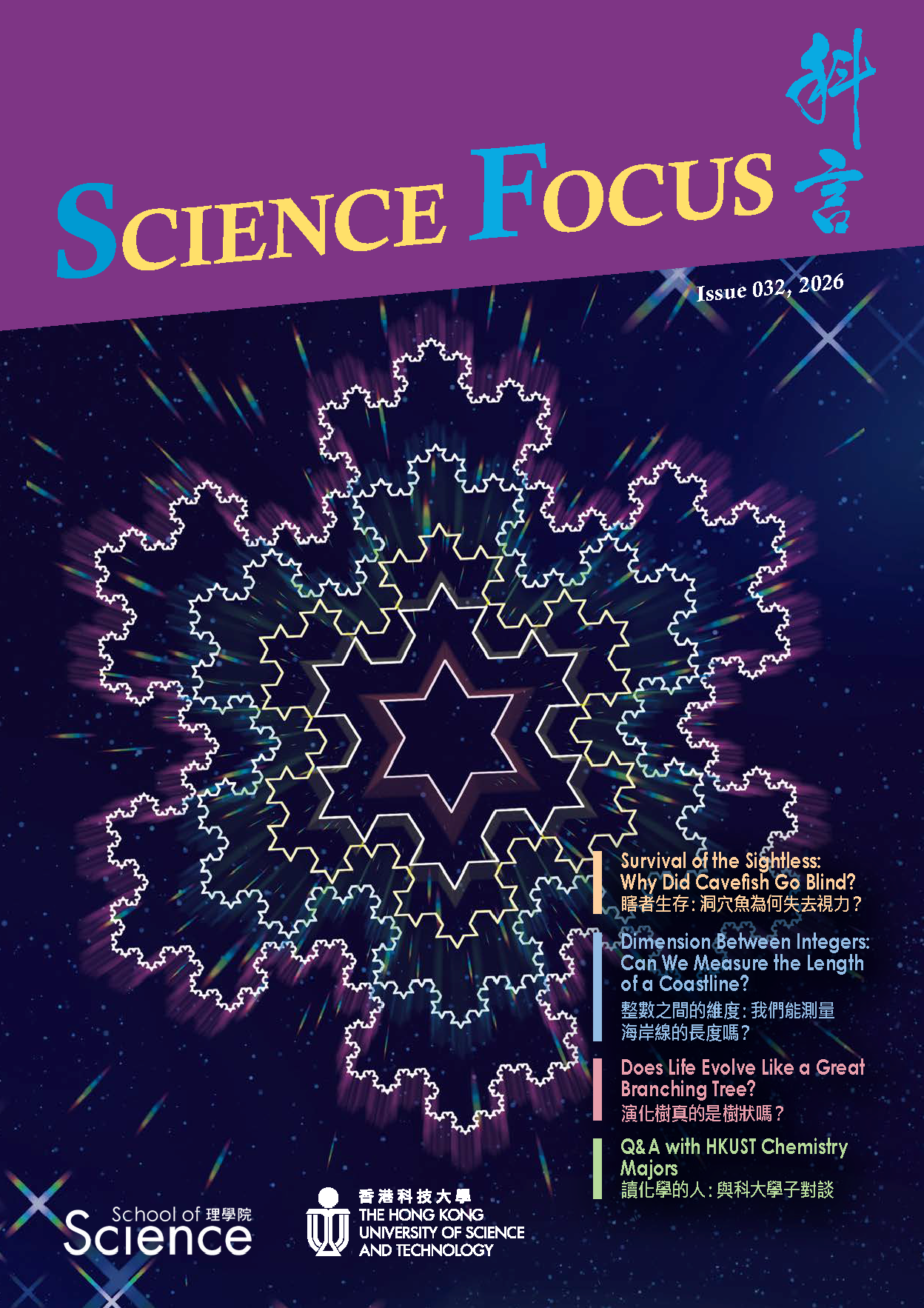
No. 31
Science Focus
Science Focus由理学院本科生在教职员的指导下编写及设计。旨在透过有趣的科研文章以启发及培育学生于科学及科研发现的兴趣。
就读
理学院
本科生
课程
注入新元素,使课程更加多样化,并增加跨学科课程,培养学生独立探索的能力。
研究生
课程
紧贴最新的科技发展,为学生提供具备启发性思维的训练。
学术单位
化学系
生命科学部
数学系
海洋科学系
物理系
化学系
化学系的教职员既充满朝气,亦具备群策群力的团队精神。他们活跃于化学研究的各个领域,其研究成果更获得国际认同。
生命科学部
生命科学部旨在促进生物科学的科研和教育之发展。
数学系
数学系的两大基柱为追求卓越的研究成果及承诺提供高效优质的教学课程。
海洋科学系
本系旨在带领各方认识不同领域的海洋科技,包括有关海洋保育,气候变化,海洋资源管理,社会经济及可持续发展的基础概念和实践。
物理系
物理系的使命乃由教学、科研及创新这铁三角组成。
科目研究
突破科研界限,追求新发现及建立崭新的研究模式。