更多科大概览

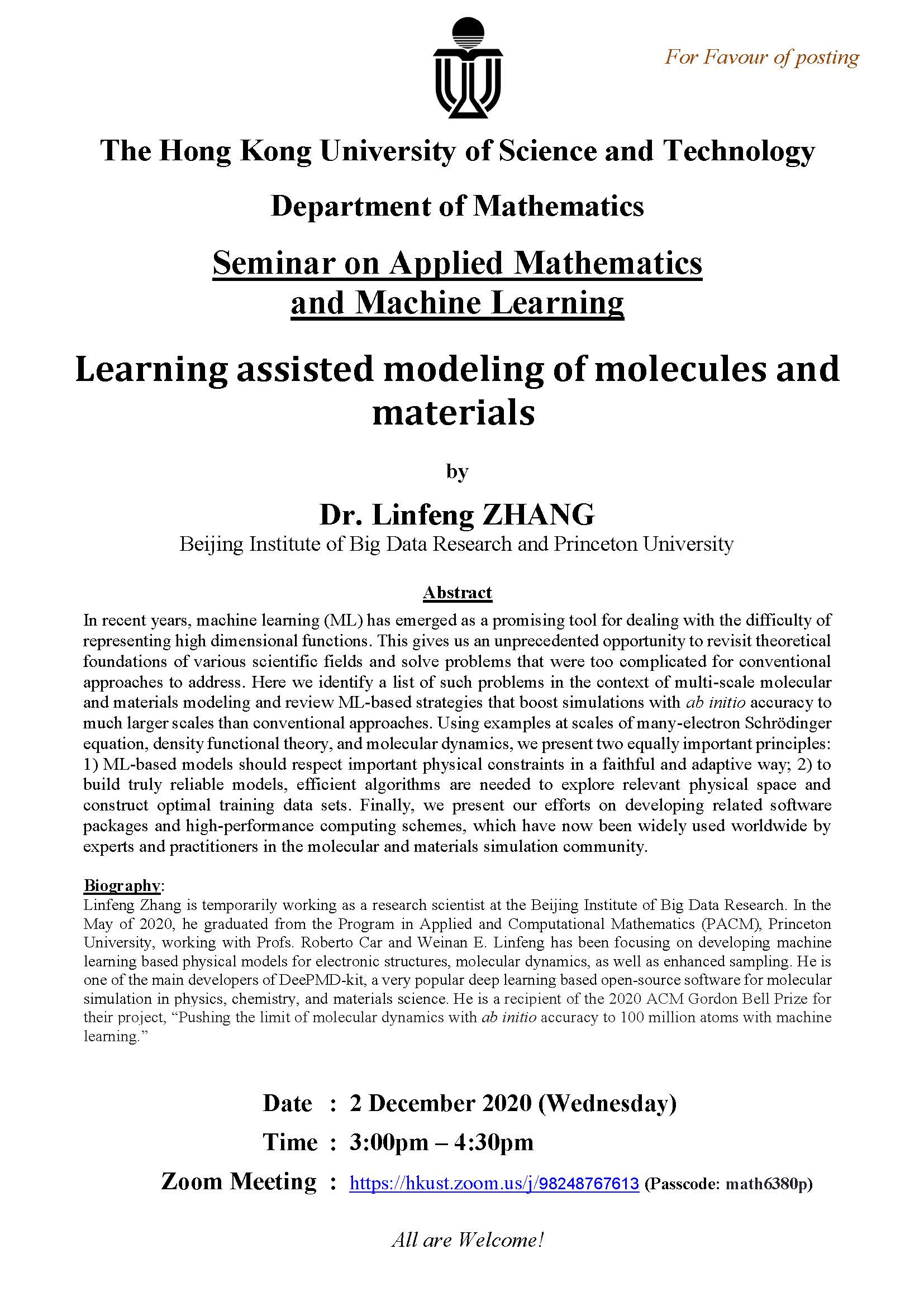
12月2日
3:00pm - 4:30pm
研讨会, 演讲, 讲座

In recent years, machine learning (ML) has emerged as a promising tool for dealing with the difficulty of representing high dimensional functions. This gives us an unprecedented opportunity to revisit theoretical foundations of various scientific fields and solve problems that were too complicated for conventional approaches to address. Here we identify a list of such problems in the context of multi-scale molecular and materials modeling and review ML-based strategies that boost simulations with ab initio accuracy to much larger scales than conventional approaches. Using examples at scales of many-electron Schrödinger equation, density functional theory, and molecular dynamics, we present two equally important principles: 1) ML-based models should respect important physical constraints in a faithful and adaptive way; 2) to build truly reliable models, efficient algorithms are needed to explore relevant physical space and construct optimal training data sets. Finally, we present our efforts on developing related software packages and high-performance computing schemes, which have now been widely used worldwide by experts and practitioners in the molecular and materials simulation community.
12月2日
3:00pm - 4:30pm

地点
https://hkust.zoom.us/j/98248767613 (Passcode: math6380p)
讲者/表演者
Dr. Linfeng ZHANG
Beijing Institute of Big Data Research and Princeton University
Beijing Institute of Big Data Research and Princeton University
主办单位
Department of Mathematics
联系方法
付款详情
对象
Alumni, Faculty and staff, PG students, UG students
语言
英语
其他活动
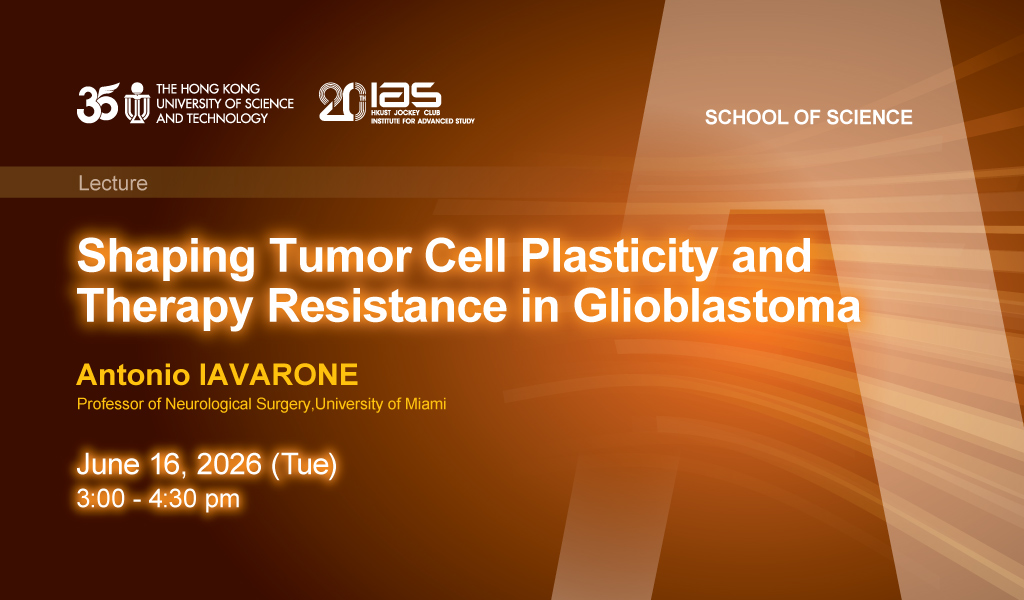
6月16日
研讨会, 演讲, 讲座
IAS / School of Science Joint Lecture - Shaping Tumor Cell Plasticity and Therapy Resistance in Glioblastoma
Abstract
Tumor heterogeneity fueled by plasticity and genetic diversification of cancer cells is key to therapy failure of malignant glioma. The speaker's team implemented spatial and genetic p...
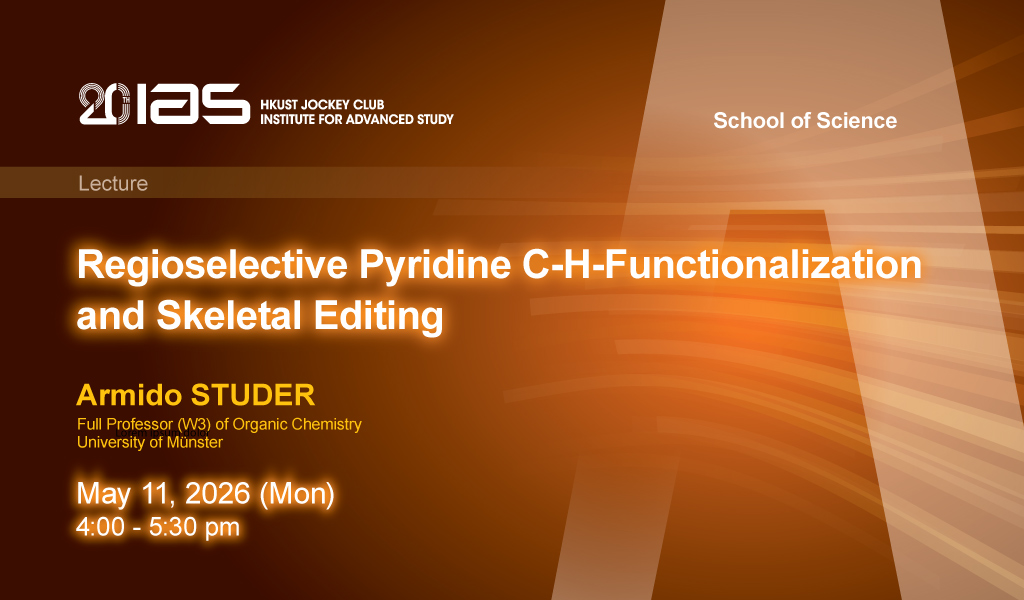
5月11日
研讨会, 演讲, 讲座
IAS / School of Science Joint Lecture - Regioselective Pyridine C-H-Functionalization and Skeletal Editing
Abstract
Pyridines belong to the most abundant heteroarenes in medicinal chemistry and in agrochemical industry. In the lecture, highly regioselective pyridine C-H functionalization through a d...