Welcome

Inspiring a culture for sustainable innovation.

Pushing the boundaries of innovation, making new discoveries and establishing new research paradigms.

About the school
Committed to pursuing cutting-edge research, making groundbreaking discoveries and establishing new research paradigms.
Our quality and well-balanced education places particular emphasis on grit, curiosity and creativity…
At the School of Science, we promote a vibrant and dynamic environment that emphasizes academic excellence, scholarship, innovation and collaboration.
Yung Hou WONG
DEAN OF SCIENCE
Events
Seminar, Lecture, Talk | 16 Jun 2026
IAS / School of Science Joint Lecture - Shaping Tumor Cell Plasticity and Therapy Resistance in Glioblastoma
Abstract Tumor heterogeneity fueled by plasticity and genetic diversification of cancer cells is key to therapy failure of malignant glioma. The speaker's team implemented spatial and genetic platforms at single cell resolution to explore the trajectory of evolution of glioblastoma.  Using spatial analysis of whole glioblastoma sections, the team established a homotypic clustered cell identity paradigm whereby tumor cell state coherence was maximal in cells organized in homotypic clusters, whereas dispersed cells downregulated the original state, acquired alternative phenotypes and exhibited changes in the microenvironment, thus linking the process of plasticity to loss of the cell adhesion mechanisms that preserve the clustered spatial pattern of glioblastoma cells. The team also used single cell DNA-sequencing methods integrated with the single cell transcriptome of patient-matched primary-recurrent glioblastoma pairs to resolve the clonal substructure of untreated glioblastoma and determine the clonal evolution at recurrence driven by therapeutic resistance. The evolutionary trajectory of glioblastoma identified a bottleneck model as the predominant pattern of evolution and converged on the identification of a rare persister subclonal state in primary glioblastoma exhibiting distinct phenotypic hallmarks that evolves and diversifies to populate the recurrent tumor mass. The team used preclinical tumor models to trace the individual lineages associated with the persister subclones and experimentally illuminated the biological and metabolic activities of the persister cellular state in brain tumors. Persister glioblastoma cells in untreated tumors lacked spatial segregation and were independent predictors of timing to recurrence for glioblastoma patients. Thus, genetic and non-genetic co-evolution mechanisms forge the acquisition of plasticity and therapy resistance in glioblastoma.   About the Speaker Prof. Antonio IAVARONE is Professor of Neurological Surgery, the Deputy Director of the Sylvester Comprehensive Cancer Center and the Director of the Sylvester Brain Tumor Institute at the University of Miami where he leads a lab composed of experimental and computational biologists working alongside clinician-scientists. By focusing on pediatric and adult brain tumors, the Iavarone lab has dissected the genetic and non-genetic mechanisms marking initiation and progression of cancer from normal brain. Prof. Iavarone discovered FGFR–TACC gene fusions, the most frequent gene fusion across human tumors. He uncovered a fusion-linked metabolic program-increased mitochondrial respiration-that creates vulnerabilities, providing a mechanistic rationale for biomarker-driven therapeutic strategies and therapies for cancers. He established that brain tumors are maintained by discrete, regulatable cell states enforced by identifiable driver lesions and “master” regulatory programs. His early studies defined core principles of cell-cycle and lineage control relevant to oncogenesis, including ID proteins as retinoblastoma-linked effectors and mechanisms coupling cell-cycle exit to neuronal differentiation.  Prof. Iavarone brought systems-level approaches into neuro-oncology by defining transcriptional modules that initiate and sustain mesenchymal transformation, a key driver of aggressiveness and treatment failure. He led/co-led large-scale efforts integrating multi-omics into tumor taxonomies. His pathway-based glioblastoma classification uncovered a mitochondrial subtype with therapeutic liabilities, and network-based analyses nominated candidate master kinases and regulators supporting rational combination strategies. Complementing this, his work in NF1-associated glioma defined the molecular landscape of a clinically challenging population, enabling precision diagnostics and risk-informed management for sporadic and genetically predisposed cancer of the brain.   For Attendees' Attention Seating is on a first come, first served basis.
Seminar, Lecture, Talk | 11 May 2026
IAS / School of Science Joint Lecture - Regioselective Pyridine C-H-Functionalization and Skeletal Editing
Abstract Pyridines belong to the most abundant heteroarenes in medicinal chemistry and in agrochemical industry. In the lecture, highly regioselective pyridine C-H functionalization through a dearomatization/rearomatization sequence will be discussed. The dearomatized oxazino pyridines can be easily prepared on a large scale, and meta-functionalization becomes achievable through light-initiated radical alkylation and ionic transformations.1 As example, using such an approach meta-fluorinated pyridines are readily accessible.2 The same intermediates upon protonation to give the corresponding pyridinium salts also allow the highly regioselective radical Minisci para-alkylation.3,4 In addition, Cu-catalyzed meta-arylation5 and switchable radical para/meta-difluoromethylation6 through such intermediates will be presented. Radical meta-nitration7 and ionic meta-hydroxylation8 work equally well through such intermediates. Finally, it will be shown that this dearomatization concept is also applicable to pyridine skeletal editing.9 Further, it will be discussed that an alternative radical dearomatization process can be used for C to N mutation in indoles and benzofurans.10   References 1. Cao, H.; Cheng, Q.; Studer, A. Science 2022, 378, 779. For a review, see: Bhattacharya, D.; Haring, M.; Studer, A. Chimia 2025, 79, 476. 2. Haring, M.; Balanna, K.; Cheng, Q.; Lammert, J.; Studer, A. J. Am. Chem. Soc. 2024, 146, 30758 3. Cao, H.; Bhattacharya, D.; Cheng, Q., Studer, A. J. Am. Chem. Soc. 2023, 145, 15581. 4. Wang, Z.; Xu, P.; Studer, A. Org. Chem. Front. 2024, 11, 3849. 5. Guo, S.-M.; Xu, P.; Studer, A. Angew. Chem. Int. Ed. 2024, 63, e202405385. 6. Xu, P.; Wang, Z.; Guo, S.-M.; Studer, A. Nat. Commun. 2024, 15, 4121. 7. Balanna, K.; Studer, A. J. Am. Chem. Soc. 2025, 147, 7485. 8. Bhattacharya, D.; Studer, A. Angew. Chem. Int. Ed. 2025, 64, e202423512. 9. Cheng, Q.; Bhattacharya, D.; Haring, M.; Cao, H.; Mück-Lichtenfeld, C.; Studer, A. Nat. Chem. 2024, 16, 741. 10. Wang, Z.; Xu, P.; Guo, S.-M.; Daniliuc, C. G.; Studer, A. Nature 2025, 642, 92.   About the Speaker Prof. Armido STUDER received his Diploma in 1991 and his PhD in 1995 from ETH Zürich under the direction of Prof. Dieter SEEBACH. He completed postdoctoral studies at the University of Pittsburgh with Prof. Dennis P. CURRAN. In 1996, he started his independent career at the ETH Zürich. In 2000, he was appointed as Associate Professor of Organic Chemistry at the Philipps-University Marburg and in 2004 as Full Professor (C4) of Organic Chemistry at the Westfälische- Wilhelms-University Münster. Since 2009, he has held a Full Professor (W3) position in Organic Chemistry at the University of Münster and has served as the Director of its Institute of Organic Chemistry. Prof. Studer has been honored with a series of prestigious awards including the Gottfried Wilhelm Leibniz Prize (2026), the Adolf Von Baeyer Commemorative Medal (2025), the Paracelsus Prize of the Schweizerische Chemische Gesellschaft (2024), and the Arthur C. Cope Late Career Scholars Award (2024), among other notable recognitions. He has been elected as a member of the European Academy of Sciences, the Academia Europaea, and the German National Academy of Sciences, alongside his designation as a Fellow of The Royal Society of Chemistry.   For Attendees' Attention Seating is on a first come, first served basis.    
Seminar, Lecture, Talk | 20 Jan 2026
IAS / School of Science Joint Lecture - A Journey to Defect Science and Engineering
Abstract A defect in a material is one of the most important concerns when it comes to modifying and tuning the properties and phenomena of materials. The speaker will review his study of defects over the course of his professional career, reflecting on his journey through the history of this research as he prepares to retire from the university where he has worked for more than 30 years. The review will include the study of intrinsic and extrinsic defects since the defects can be introduced in various ways, either intrinsically or extrinsically.   The journey began with the study of ferroelectric oxides applied to non-volatile ferroelectric memories 35 years ago, when one of the reliabilities for the realization of ferroelectric memories was a critical issue. The defect intensively coined at the reliability issue was an oxygen vacancy, which is a fundamental and intrinsic defect. The oxygen deficiency inevitably occurs in oxides greatly affects fatigue and imprint reliability. The fatigue had been resolved by the use of oxide electrode, either doped layered perovskite ferroelectrics. The study on the oxygen vacancy defects continued on low d-electron occupancy perovskites among transition metal oxides and rare-earth fluorite oxides in the f-electron system. The first-principles calculations suggested that oxygen vacancies tended to cluster along a specific direction, i.e., 001 direction in SrTiO3, followed by experimental validation. Ferromagnetism evolved from heavily oxygen-deficient CeO2, known for its role as an oxygen reservoir. Oxygen vacancy engineering was also used to induce two-phase coexistence with different transition temperatures to mimic the two-phase coexistence during the first-order phase transition. From oxygen vacancy engineering, the isostructural metal-insulator transition of VO2 was predicted and validated while structural and electronic transitions were known to be coupled in the transition. Initiated by the oxygen vacancy clustering along the specific direction, the defect study was extended to the geometrical aspect of defect distribution and location at the atomic scale. The control of extrinsic defect distribution led to considering materials dimensionality in fractional number, whereas materials dimensionality used to be defined by integral number, i.e., 0, 1, 2, 3D. Theoretical and experimental studies revealed that the geometrical control of defect distribution (La doped SrTiO3), namely geometrical doping, led to a wide span of material states from a highly symmetric charge fluid to a charge disproportionated insulating state. Geometrical doping is added as another axis to the fundamental parameters of chemical doping, such as the amount and type of defect. The formation energy of oxygen vacancies was studied by machine learning (ML), since the oxygen vacancy is an intrinsic defect and the tendency of oxygen vacancy formation is an important concern from a material state to device performance. The formation energy of oxygen vacancies was predicted for more than 30,000 oxides available in the periodic table using an ensemble ML model, which is the last study of the defect in this journey at Sunkyunkwan University.   About the Speaker Prof. Jaichan LEE earned his PhD in Ceramic Science and Engineering from Rutgers University, USA, in 1993. He obtained his MS in Materials Science and Engineering from KAIST, Korea, in 1985, and his BS in Metallurgical Engineering from Seoul National University, Korea, in 1983. Prof. Lee is a Professor in the Department of Advanced Materials Science and Engineering at Sungkyunkwan University (SKKU) since 1995. From 1993 to 1994, he served as a Postdoctoral Member of Technical Staff at Bell Communications Research in the USA. Prior to his current role, he worked as a Member of Technical Staff at Samsung Advanced Institute of Technology from 1987 to 1989, and at Samsung Electro-Mechanics Co. from 1985 to 1987. Prof. Lee’s significant contributions to the field have been recognized through various awards and honors, including the Success Award in Engineering from SKKU in 2019, and serving as President of The Korean Dielectrics Society from 2019 to 2021. He has also chaired the Ferroelectrics/Dielectrics Symposium from 2007 to 2021 and the 10th and 11th Korea-Japan Conference on Ferroelectrics from 2012 to 2016.    For Attendees' Attention Seating is on a first come, first served basis.
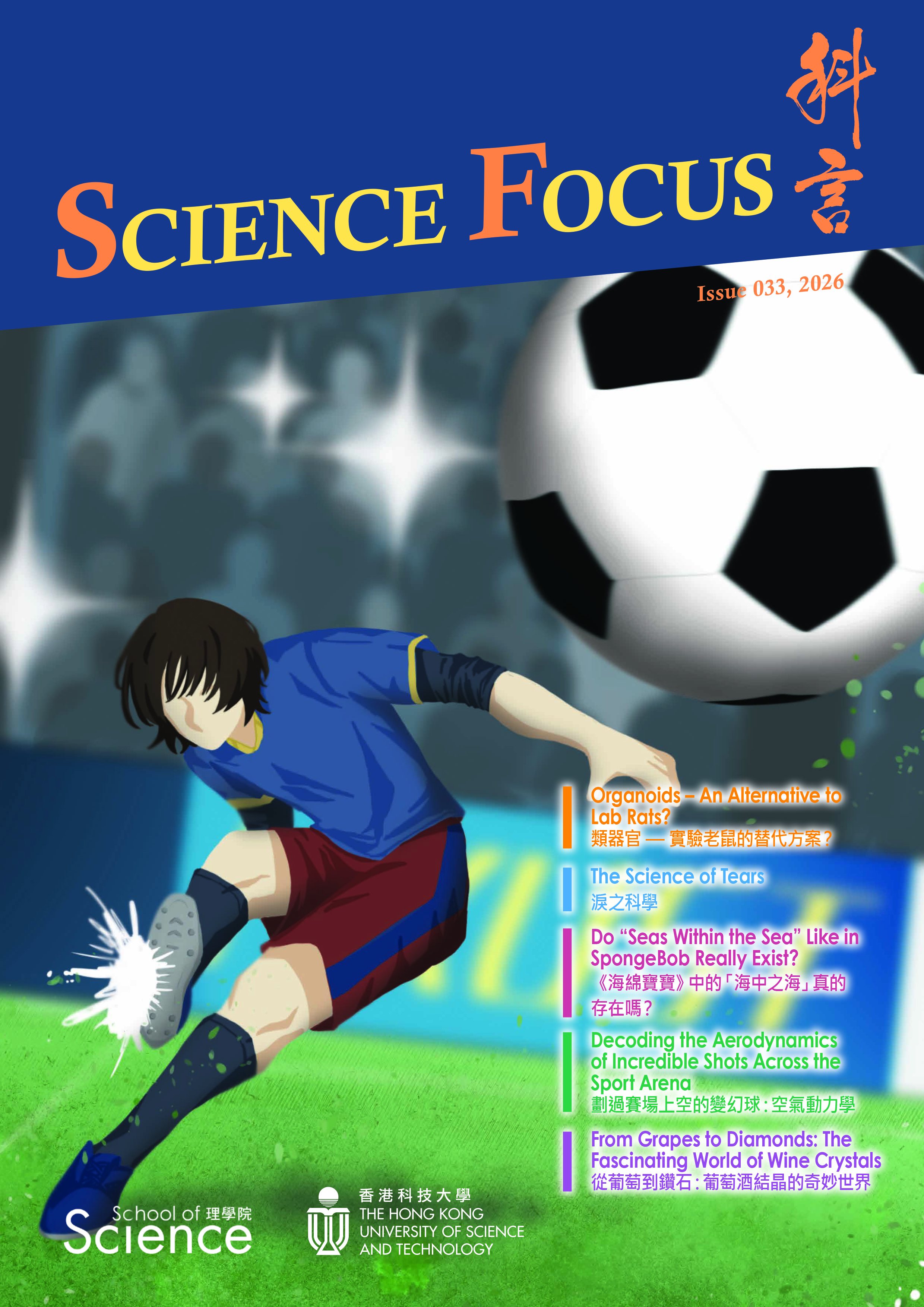
No. 32
Science Focus
Created by science UG students with faculty guidance, Science Focus aims at sparking students’ interest in science and scientific research through interesting articles.
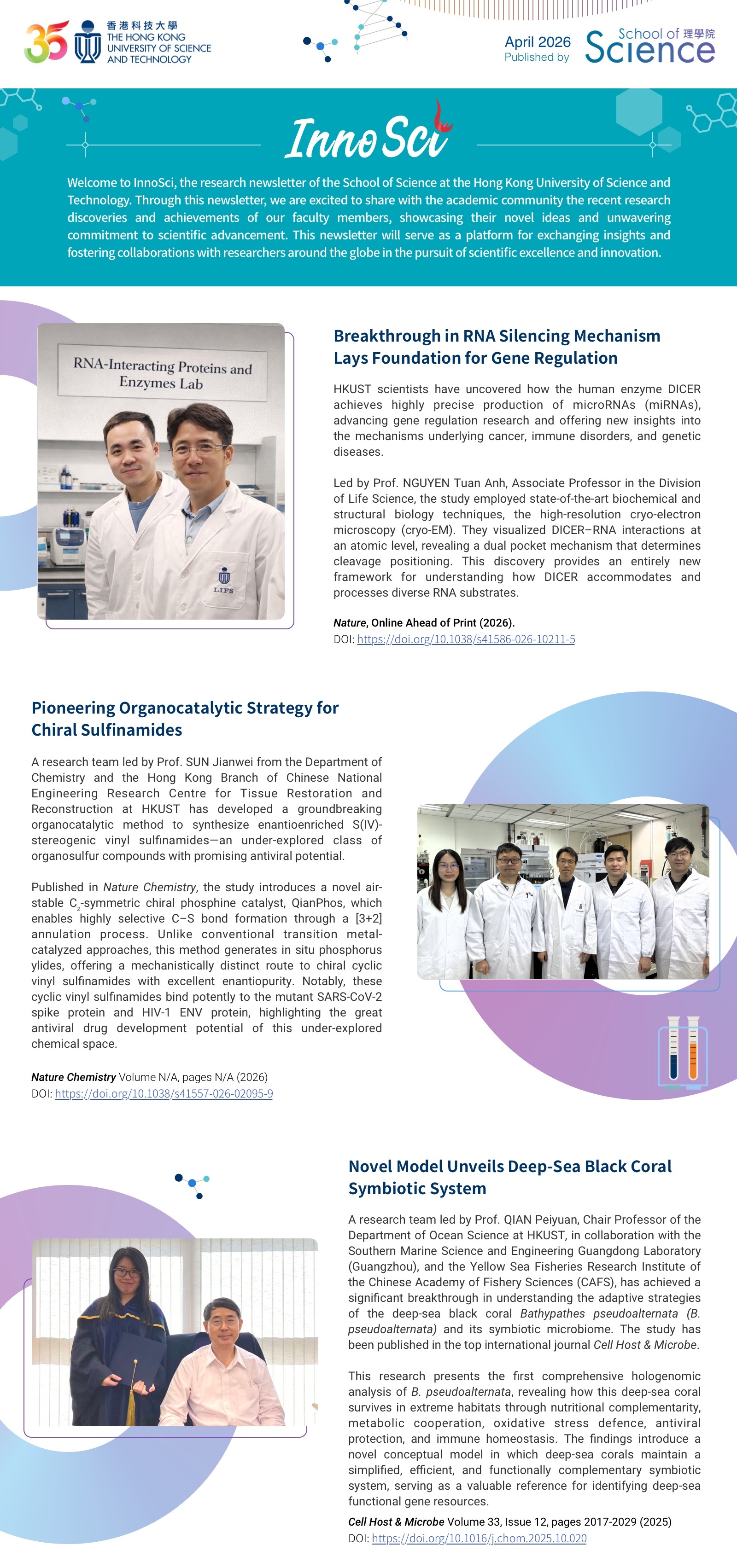
InnoSci
InnoSci, the research newsletter of the School of Science, shares our faculty members' recent research discoveries and achievements, showcasing their novel ideas.
Study at the
School of Science
Undergraduate
Programs
Offering diverse, interdisciplinary and inquiry-driven undergraduate education in an intellectually stimulating environment.
Postgraduate
Programs
Providing students with exposure and hands-on training in innovative, cutting edge methodologies and technologies via research and taught postgraduate education.
Academic Units
Chemistry
Life Science
Mathematics
Ocean Science
Physics
Chemistry
The Department of Chemistry has dynamic, friendly and cooperative faculty members active in all areas of chemical research and whose research is internationally recognized.
Life Science
The mission of the Division of Life Science is to facilitate the advancement of both research and education in the field of biological sciences.
Mathematics
Excellence in research and a commitment to deliver effective and quality teaching programs, are the two pillars on which the Department of Mathematics is based.
Ocean Science
The Department of Ocean Science aims to lead in understanding ocean science and technology, marine conservation, global climate change, management of marine resources, socio-economy and sustainable development.
Physics
The mission of the Department of Physics is captured by the triangle of teaching, research and innovation.
Research
Pushing the boundaries of innovation, making new discoveries and establishing new research paradigms.