More about HKUST
29 May 2023
11:00am - 12:00pm
Seminar, Lecture, Talk

The discrete unified gas-kinetic scheme (DUGKS) is a numerical method developed for multiscale flows based on the gas kinetic model equation. With the coupling of the collision and transport dynamics in the flux reconstruction, DUGKS can effectively simulate gas flows in all flow regimes, particularly continuum flows without resolving the kinetic scale. In this talk, a rigorous theoretical analysis of the asymptotic properties of DUGKS within the unified preserving (UP) framework is presented, which provides the asymptotic degree of the scheme. It is shown that the DUGKS is the second-order Lax-Wendroff scheme for the collision-less kinetic equation as the Knudsen number (ϵ) approaches to infinity; while in the continuum limit, DUGKS is consistent with the Navier-Stokes equations as the mesh size Δx=o(√ϵ) and time step Δt=o(√ϵ). Several related kinetic schemes are also analyzed for comparison. The analysis reveals that the space-time coupling is important in developing UP kinetic schemes. Numerical test of the Taylor vortex in a periodic domain confirms the theoretical analysis.
29 May 2023
11:00am - 12:00pm

Where
Room 1410 (near Lift 25/26)
Speakers/Performers
Prof. Zhaoli GUO
Huazhong University of Science and Technology
Huazhong University of Science and Technology
Organizer(S)
Department of Mathematics
Contact/Enquiries
Payment Details
Audience
Faculty and staff, General public, PG students, UG students
Language(s)
English
Other Events
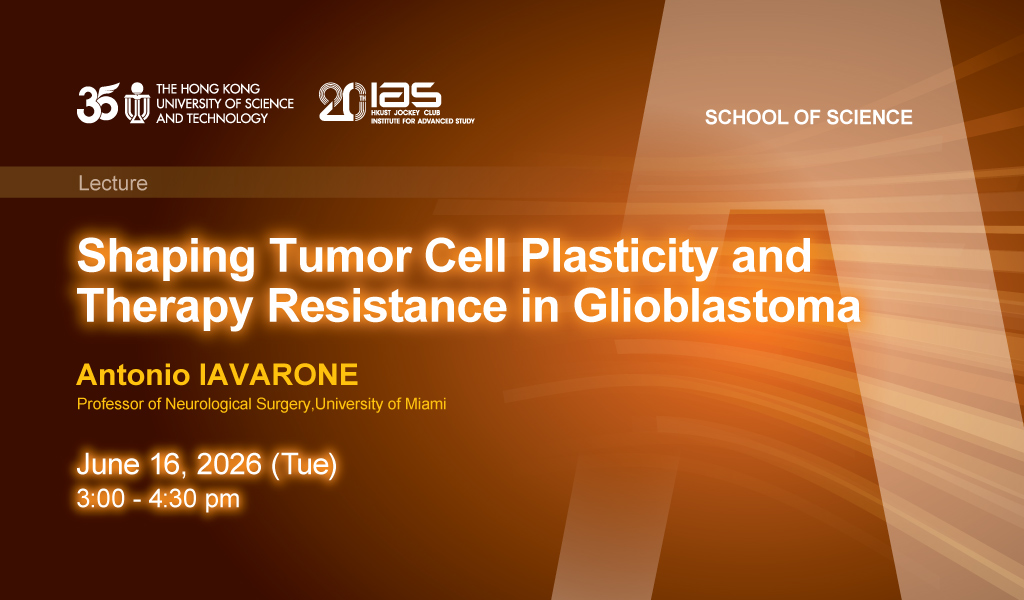
16 Jun 2026
Seminar, Lecture, Talk
IAS / School of Science Joint Lecture - Shaping Tumor Cell Plasticity and Therapy Resistance in Glioblastoma
Abstract
Tumor heterogeneity fueled by plasticity and genetic diversification of cancer cells is key to therapy failure of malignant glioma. The speaker's team implemented spatial and genetic p...
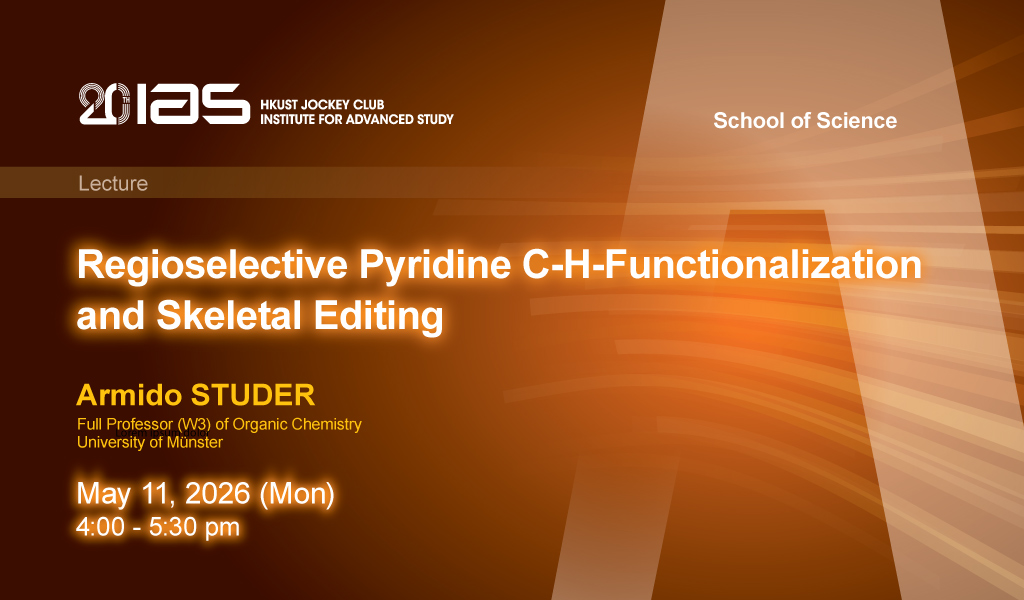
11 May 2026
Seminar, Lecture, Talk
IAS / School of Science Joint Lecture - Regioselective Pyridine C-H-Functionalization and Skeletal Editing
Abstract
Pyridines belong to the most abundant heteroarenes in medicinal chemistry and in agrochemical industry. In the lecture, highly regioselective pyridine C-H functionalization through a d...