More about HKUST

5 May 2021
2:00pm - 3:00pm
Seminar, Lecture, Talk

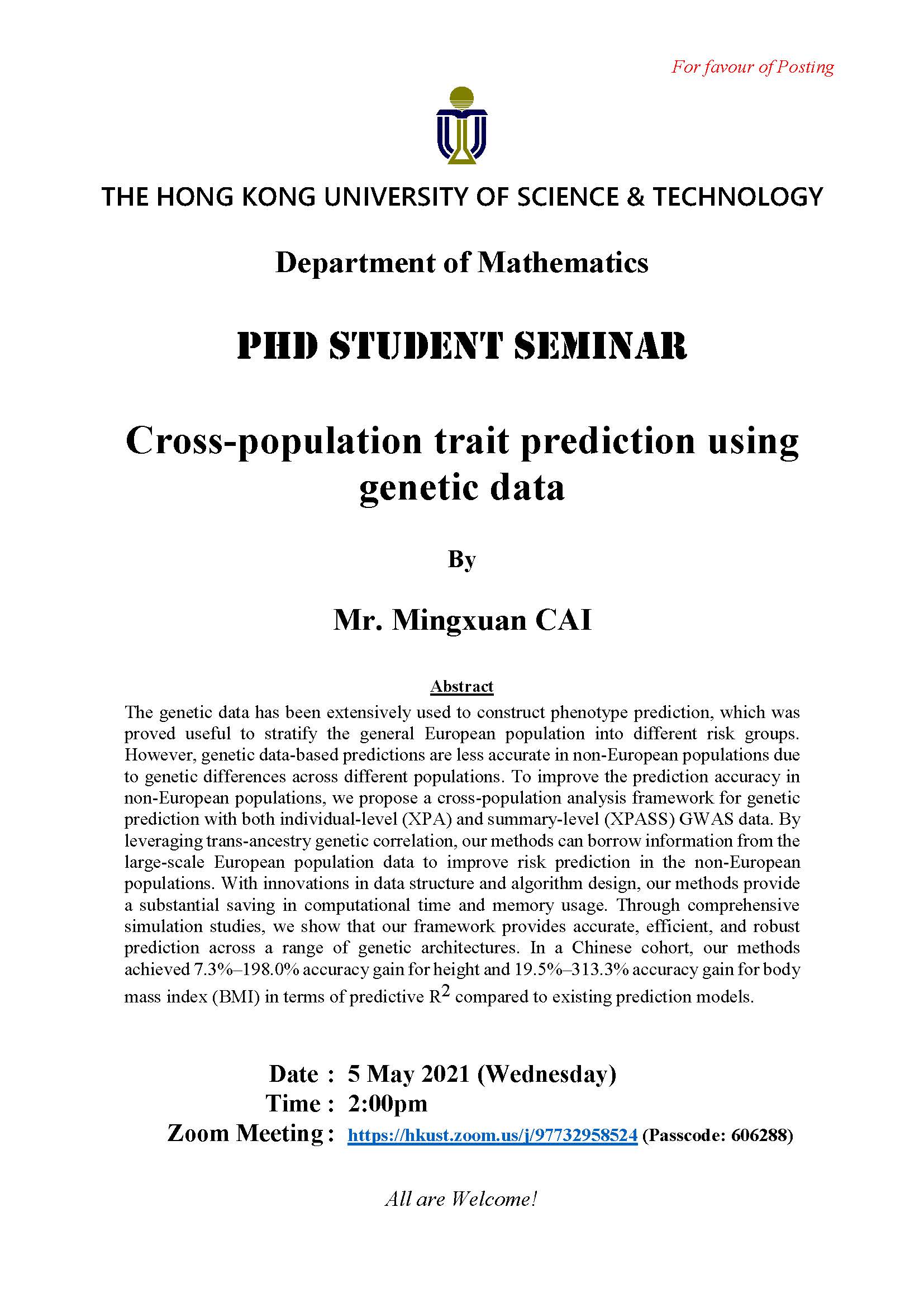
The genetic data has been extensively used to construct phenotype prediction, which was proved useful to stratify the general European population into different risk groups. However, genetic data-based predictions are less accurate in non-European populations due to genetic differences across different populations. To improve the prediction accuracy in non-European populations, we propose a cross-population analysis framework for genetic prediction with both individual-level (XPA) and summary-level (XPASS) GWAS data. By leveraging trans-ancestry genetic correlation, our methods can borrow information from the large-scale European population data to improve risk prediction in the non-European populations. With innovations in data structure and algorithm design, our methods provide a substantial saving in computational time and memory usage. Through comprehensive simulation studies, we show that our framework provides accurate, efficient, and robust prediction across a range of genetic architectures. In a Chinese cohort, our methods achieved 7.3%–198.0% accuracy gain for height and 19.5%–313.3% accuracy gain for body mass index (BMI) in terms of predictive R2 compared to existing prediction models.
5 May 2021
2:00pm - 3:00pm

Where
https://hkust.zoom.us/j/97732958524 (Passcode: 606288)
Speakers/Performers
Mr. Mingxuan CAI
Organizer(S)
Department of Mathematics
Contact/Enquiries
Payment Details
Audience
Alumni, Faculty and staff, PG students, UG students
Language(s)
English
Other Events

16 Jun 2026
Seminar, Lecture, Talk
IAS / School of Science Joint Lecture - Shaping Tumor Cell Plasticity and Therapy Resistance in Glioblastoma
Abstract
Tumor heterogeneity fueled by plasticity and genetic diversification of cancer cells is key to therapy failure of malignant glioma. The speaker's team implemented spatial and genetic p...

11 May 2026
Seminar, Lecture, Talk
IAS / School of Science Joint Lecture - Regioselective Pyridine C-H-Functionalization and Skeletal Editing
Abstract
Pyridines belong to the most abundant heteroarenes in medicinal chemistry and in agrochemical industry. In the lecture, highly regioselective pyridine C-H functionalization through a d...