More about HKUST

5 May 2021
4:15pm - 5:15pm
Seminar, Lecture, Talk

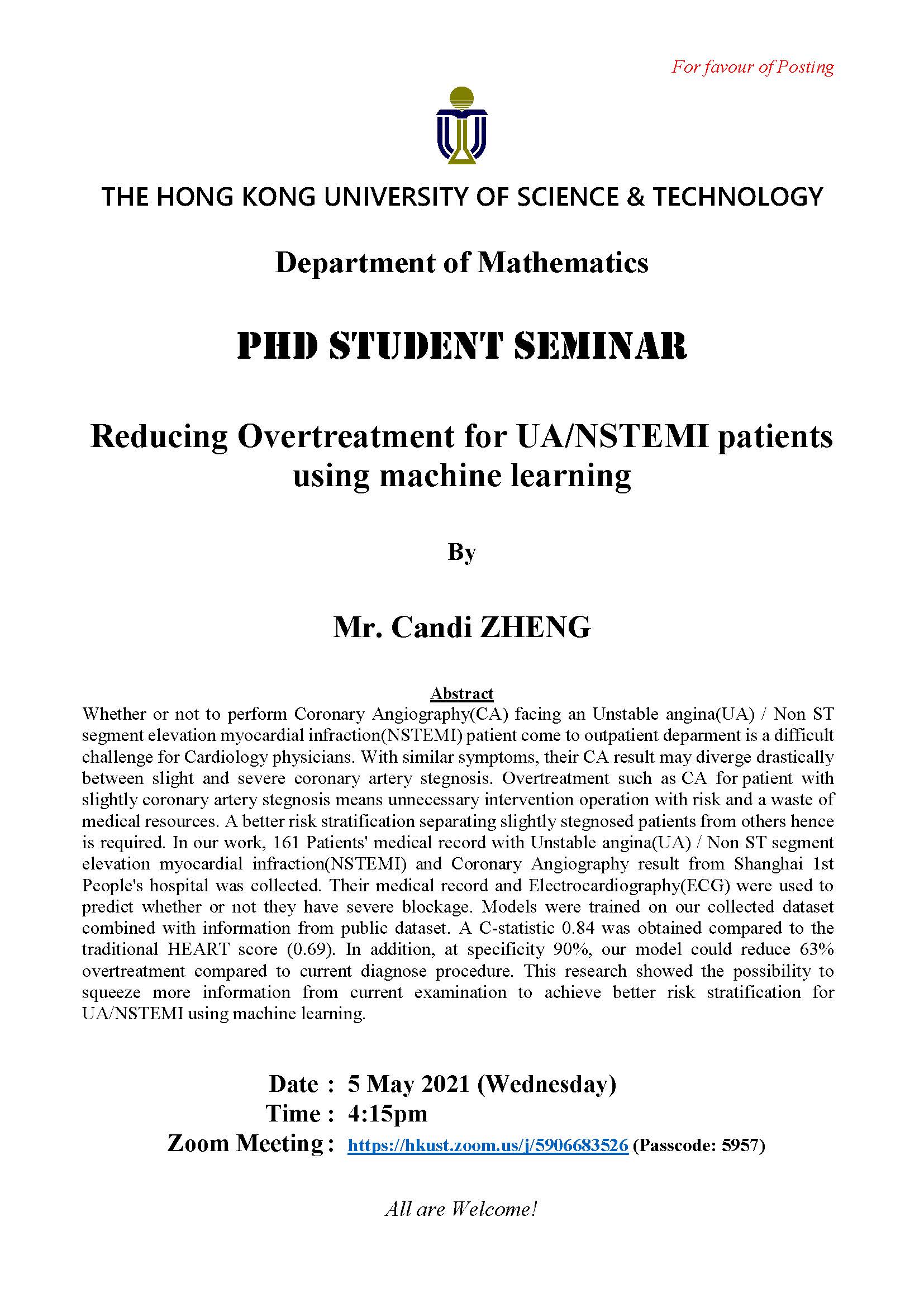
Whether or not to perform Coronary Angiography(CA) facing an Unstable angina(UA) / Non ST segment elevation myocardial infraction(NSTEMI) patient come to outpatient deparment is a difficult challenge for Cardiology physicians. With similar symptoms, their CA result may diverge drastically between slight and severe coronary artery stegnosis. Overtreatment such as CA for patient with slightly coronary artery stegnosis means unnecessary intervention operation with risk and a waste of medical resources. A better risk stratification separating slightly stegnosed patients from others hence is required. In our work, 161 Patients' medical record with Unstable angina(UA) / Non ST segment elevation myocardial infraction(NSTEMI) and Coronary Angiography result from Shanghai 1st People's hospital was collected. Their medical record and Electrocardiography(ECG) were used to predict whether or not they have severe blockage. Models were trained on our collected dataset combined with information from public dataset. A C-statistic 0.84 was obtained compared to the traditional HEART score (0.69). In addition, at specificity 90%, our model could reduce 63% overtreatment compared to current diagnose procedure. This research showed the possibility to squeeze more information from current examination to achieve better risk stratification for UA/NSTEMI using machine learning.
5 May 2021
4:15pm - 5:15pm

Where
https://hkust.zoom.us/j/5906683526 (Passcode: 5957)
Speakers/Performers
Mr. Candi ZHENG
Organizer(S)
Department of Mathematics
Contact/Enquiries
Payment Details
Audience
Alumni, Faculty and staff, PG students, UG students
Language(s)
English
Other Events
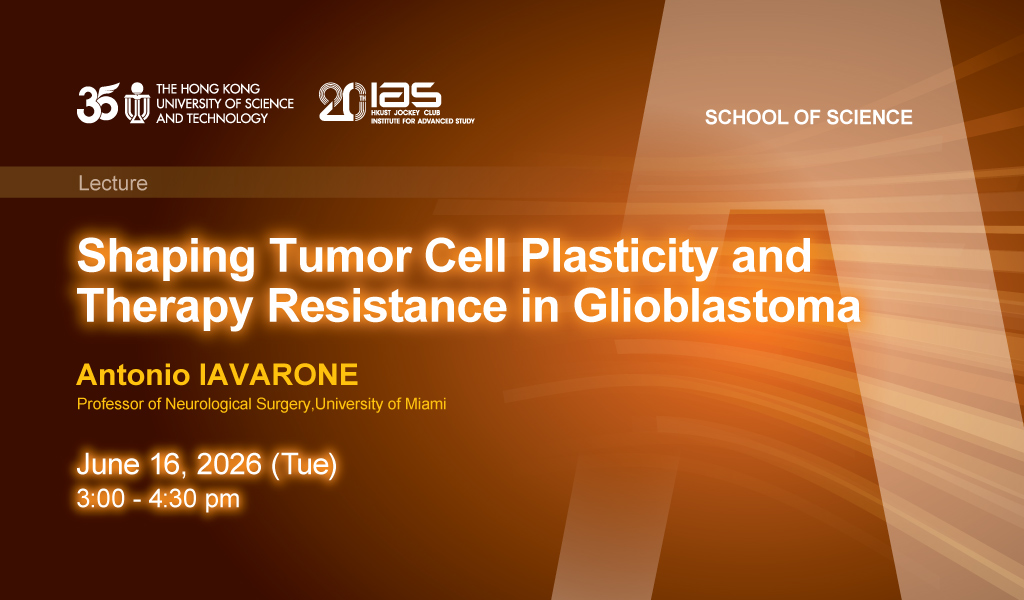
16 Jun 2026
Seminar, Lecture, Talk
IAS / School of Science Joint Lecture - Shaping Tumor Cell Plasticity and Therapy Resistance in Glioblastoma
Abstract
Tumor heterogeneity fueled by plasticity and genetic diversification of cancer cells is key to therapy failure of malignant glioma. The speaker's team implemented spatial and genetic p...
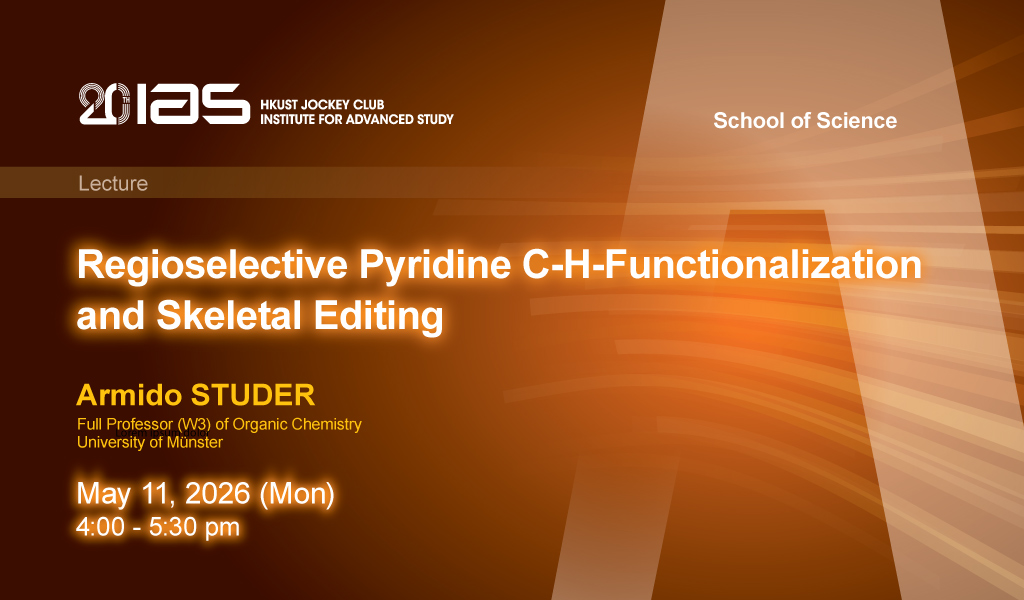
11 May 2026
Seminar, Lecture, Talk
IAS / School of Science Joint Lecture - Regioselective Pyridine C-H-Functionalization and Skeletal Editing
Abstract
Pyridines belong to the most abundant heteroarenes in medicinal chemistry and in agrochemical industry. In the lecture, highly regioselective pyridine C-H functionalization through a d...