More about HKUST

10 Jul 2023
10:00am - 11:00am
Seminar, Lecture, Talk

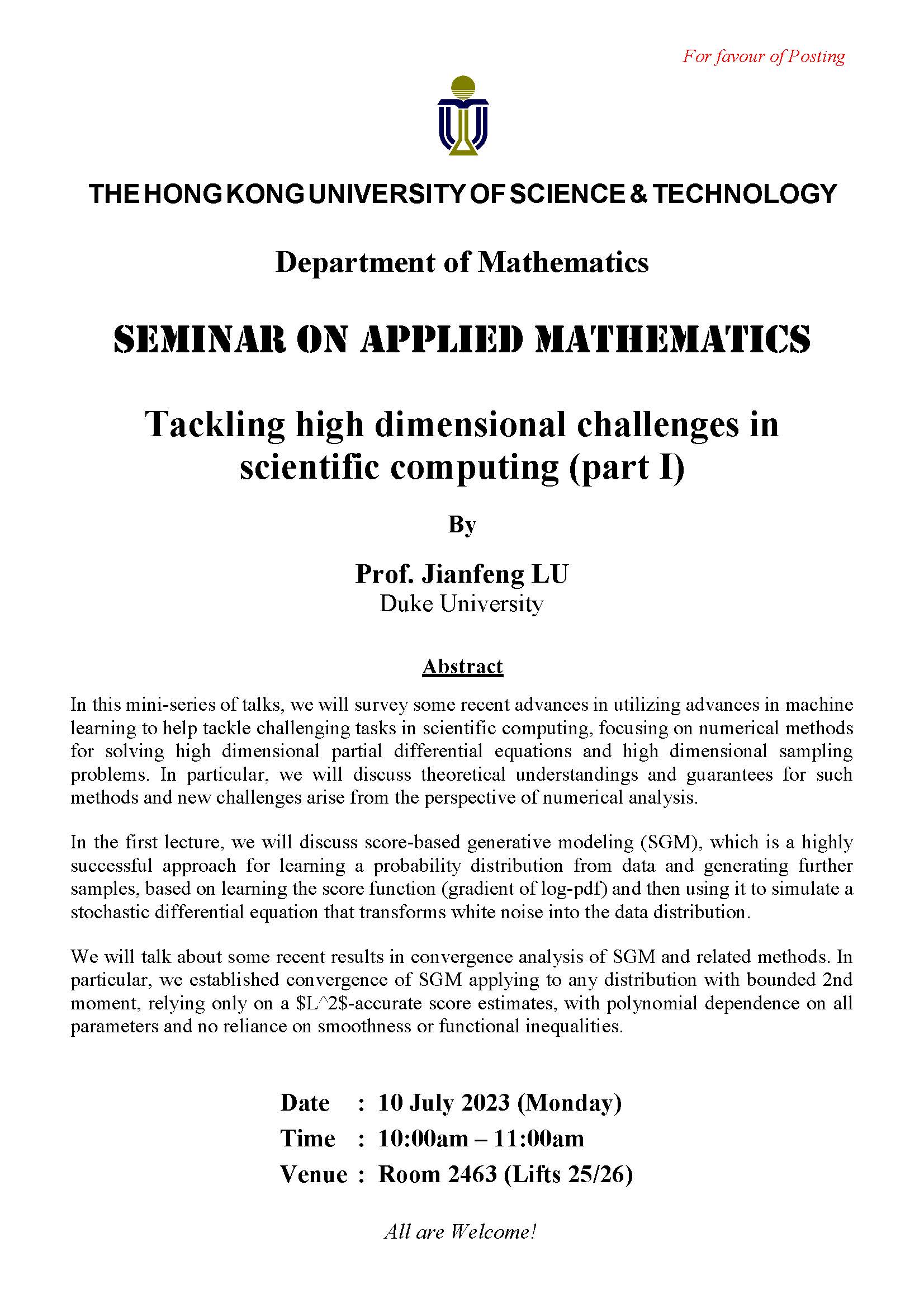
In this mini-series of talks, we will survey some recent advances in utilizing advances in machine learning to help tackle challenging tasks in scientific computing, focusing on numerical methods for solving high dimensional partial differential equations and high dimensional sampling problems. In particular, we will discuss theoretical understandings and guarantees for such methods and new challenges arise from the perspective of numerical analysis.
In the first lecture, we will discuss score-based generative modeling (SGM), which is a highly successful approach for learning a probability distribution from data and generating further samples, based on learning the score function (gradient of log-pdf) and then using it to simulate a stochastic differential equation that transforms white noise into the data distribution.
We will talk about some recent results in convergence analysis of SGM and related methods. In particular, we established convergence of SGM applying to any distribution with bounded 2nd moment, relying only on a $L^2$-accurate score estimates, with polynomial dependence on all parameters and no reliance on smoothness or functional inequalities.
10 Jul 2023
10:00am - 11:00am

Where
Room 2463 (Lifts 25/26)
Speakers/Performers
Prof. Jianfeng LU
Duke University
Duke University
Organizer(S)
Department of Mathematics
Contact/Enquiries
Payment Details
Audience
Alumni, Faculty and staff, PG students, UG students
Language(s)
English
Other Events
16 Jun 2026
Seminar, Lecture, Talk
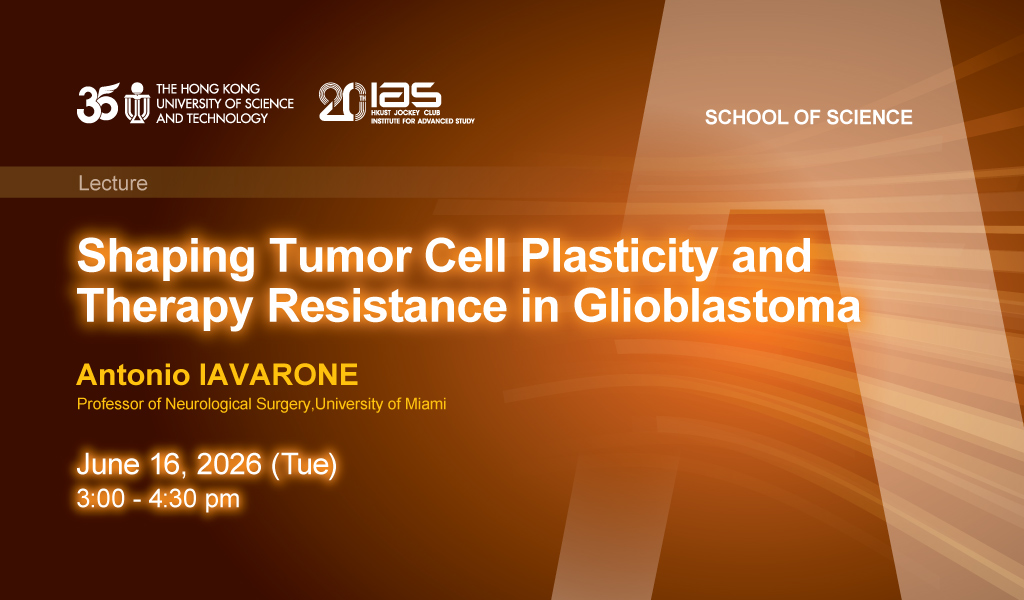
IAS / School of Science Joint Lecture - Shaping Tumor Cell Plasticity and Therapy Resistance in Glioblastoma
Abstract
Tumor heterogeneity fueled by plasticity and genetic diversification of cancer cells is key to therapy failure of malignant glioma. The speaker's team implemented spatial and genetic p...
11 May 2026
Seminar, Lecture, Talk
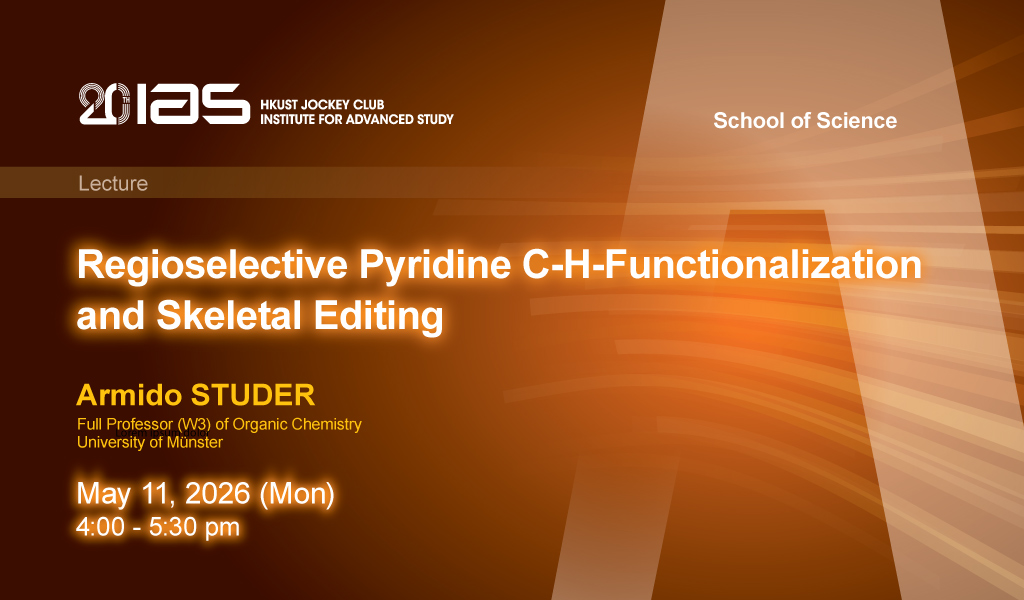
IAS / School of Science Joint Lecture - Regioselective Pyridine C-H-Functionalization and Skeletal Editing
Abstract
Pyridines belong to the most abundant heteroarenes in medicinal chemistry and in agrochemical industry. In the lecture, highly regioselective pyridine C-H functionalization through a d...