A research team led by Prof. QUAN Yangjian, Assistant Professor in the Department of Chemistry at the Hong Kong University of Science and Technology (HKUST) has achieved a breakthrough in organic synthesis by developing a novel "entangled dual-site migration" mechanism, expanding conventional single-site migration to simultaneous dual-site migration along a carbon chain. This higher-order migration paradigm offers scientists unprecedented control over complex molecular structures.
While migration reactions are indispensable tools in organic synthesis that enable precise remote functionalization on molecular skeletons, historically these pathways have largely been restricted to single-site shifts. Orchestrating the simultaneous migration of two distant sites— while controlling the chemo-, regio-, and diastereoselectivity at both migrating centers—has remained a long-standing scientific challenge.
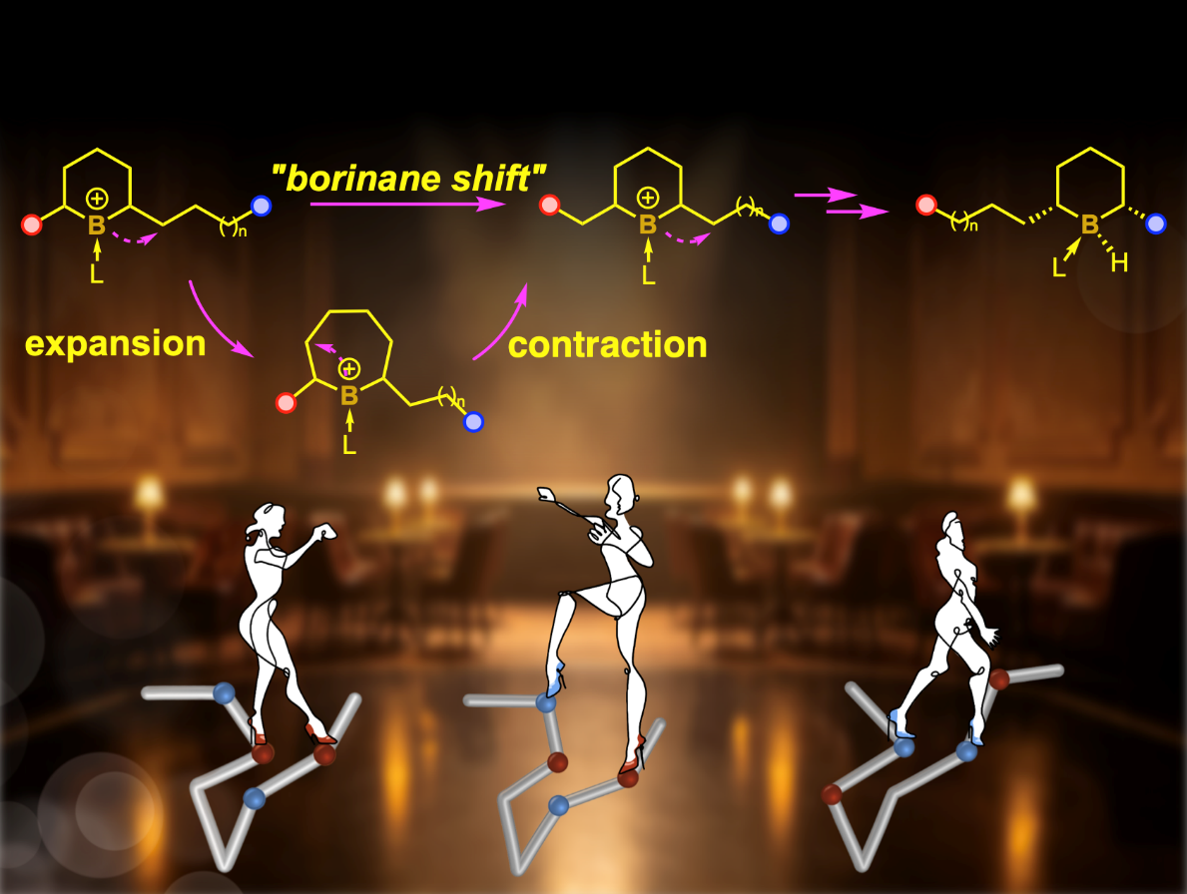
To overcome this limitation, the HKUST team proposed a key concept: a borenium species bearing two B–H units can serve as a transient bridge, tethering two distant carbon sites into a boracycle through double hydroboration. Through a stepwise "ring contraction/ring expansion" mechanism, the borinane ring migrates along the carbon chain under the guidance of a directing group. This process ultimately delivers the most thermodynamically stable product with excellent regioselectivity and diastereoselectivity.
Demonstrating the viability of this technology, the team successfully utilized (2-cyclobutylvinyl) benzene and IMe-borane as model substrates. Under borenium catalysis, the migrated borinane product was isolated in 80% yield. Through control experiments, intermediate isolation, and DFT calculations, the team validated the proposed “lead and follow” pathway, providing solid evidence for the "entangled dual-site migration" mechanism.
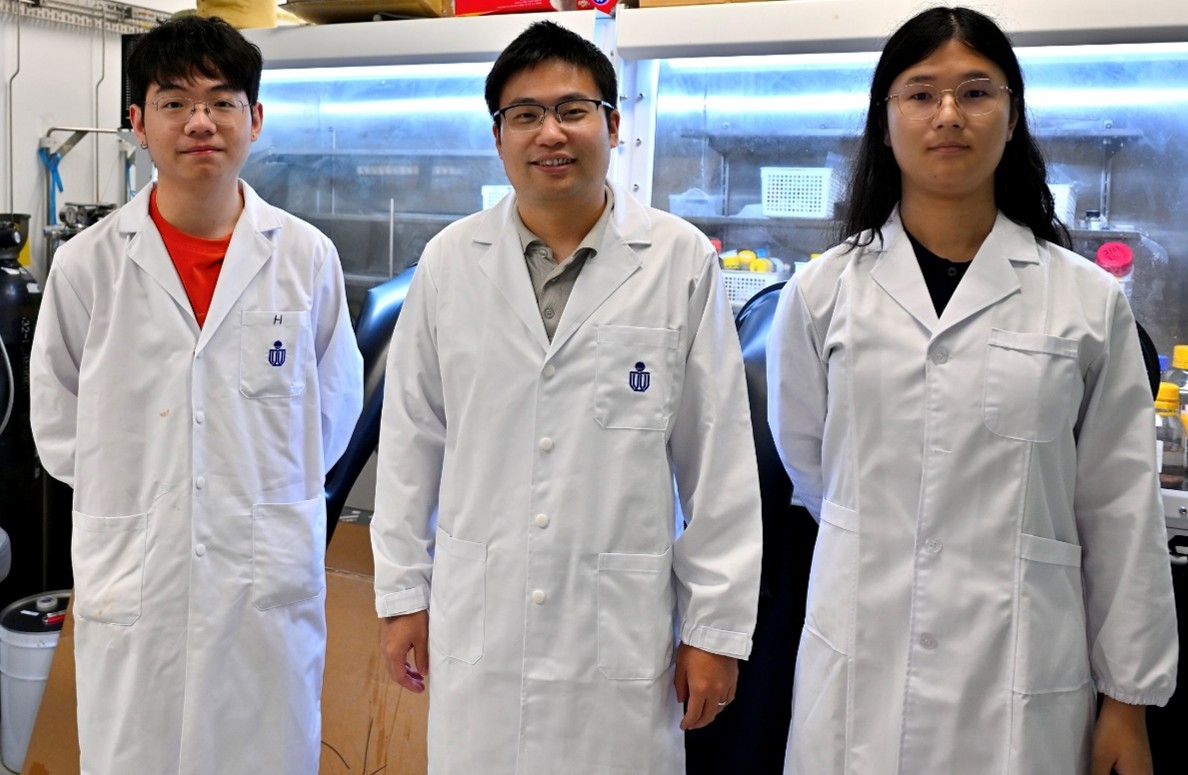
The study was independently conducted at the Department of Chemistry at HKUST and recently published in Nature. The first author is PhD candidate ZHU Zheng, who conducted most experiments. DFT calculations were performed by PhD candidate ZHANG Peiqi and Prof. LIN Zhenyang. Prof. QUAN Yangjian supervised the research project and is the corresponding author.
Reflecting on the achievement, Prof. QUAN remarked, “This ‘boracycle rearrangement’ represents a higher-order migration paradigm, expanding conventional single-site migration to dual-site migration along a carbon chain. We believe that our ‘entanglement’ strategy for controlling chemo-, regio-, and diastereoselectivity across two distant sites provides a new reference for other dual-site modification processes beyond this work, opening up uncharted opportunities for future synthetic chemistry."