More about HKUST

17 Sep 2021
10:00am - 11:00am
Seminar, Lecture, Talk

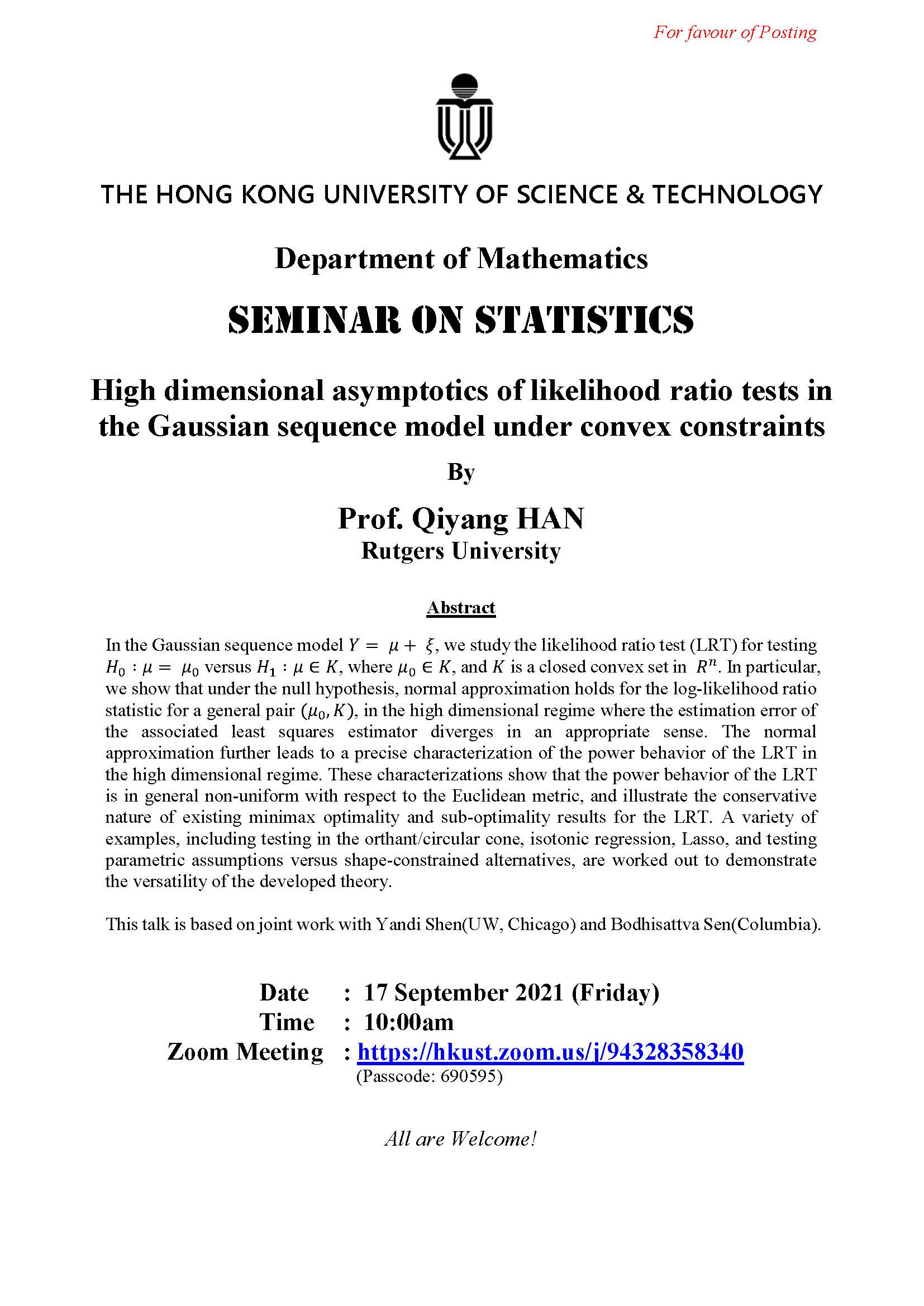
In the Gaussian sequence model Y= μ+ ξ, we study the likelihood ratio test (LRT) for testing H0 :μ= μ0
versus H1 :μ∈K
, where μ0∈K
, and K
is a closed convex set in Rn
. In particular, we show that under the null hypothesis, normal approximation holds for the log-likelihood ratio statistic for a general pair (μ0, K)
, in the high dimensional regime where the estimation error of the associated least squares estimator diverges in an appropriate sense. The normal approximation further leads to a precise characterization of the power behavior of the LRT in the high dimensional regime. These characterizations show that the power behavior of the LRT is in general non-uniform with respect to the Euclidean metric, and illustrate the conservative nature of existing minimax optimality and sub-optimality results for the LRT. A variety of examples, including testing in the orthant/circular cone, isotonic regression, Lasso, and testing parametric assumptions versus shape-constrained alternatives, are worked out to demonstrate the versatility of the developed theory.
This talk is based on joint work with Yandi Shen(UW, Chicago) and Bodhisattva Sen(Columbia).
17 Sep 2021
10:00am - 11:00am

Where
https://hkust.zoom.us/j/94328358340 (Passcode: 690595)
Speakers/Performers
Prof. Qiyang HAN
Rutgers University
Rutgers University
Organizer(S)
Department of Mathematics
Contact/Enquiries
Payment Details
Audience
Alumni, Faculty and staff, PG students, UG students
Language(s)
English
Other Events
16 Jun 2026
Seminar, Lecture, Talk
IAS / School of Science Joint Lecture - Shaping Tumor Cell Plasticity and Therapy Resistance in Glioblastoma
Abstract
Tumor heterogeneity fueled by plasticity and genetic diversification of cancer cells is key to therapy failure of malignant glioma. The speaker's team implemented spatial and genetic p...
11 May 2026
Seminar, Lecture, Talk
IAS / School of Science Joint Lecture - Regioselective Pyridine C-H-Functionalization and Skeletal Editing
Abstract
Pyridines belong to the most abundant heteroarenes in medicinal chemistry and in agrochemical industry. In the lecture, highly regioselective pyridine C-H functionalization through a d...