More about HKUST


11 Jul 2023
10:00am - 11:00am
Seminar, Lecture, Talk

The invariant distribution, which is characterized by the stationary Fokker-Planck equation, is an important object in the study of randomly perturbed dynamical systems. Traditional numerical methods for computing the invariant distribution based on the Fokker-Planck equation, such as finite difference or finite element methods, are limited to low-dimensional systems due to the curse of dimensionality. In this work, we propose a deep learning based method to compute the generalized potential, i.e. the negative logarithm of the invariant distribution multiplied by the noise. The idea of the method is to learn a decomposition of the force field, as specified by the Fodder-Planck equation, from the trajectory data. The potential component of the decomposition gives the generalized potential. The method can deal with high-dimensional systems, possibly with partially known dynamics. Using the generalized potential also allows us to deal with systems at low temperatures, where the invariant distribution becomes singular around the metastable states. These advantages make it an efficient method to analyze invariant distributions for practical dynamical systems. The effectiveness of the proposed method is demonstrated by numerical examples.
11 Jul 2023
10:00am - 11:00am

Where
Room 2463 (Lifts 25/26)
Speakers/Performers
Prof. Weiqing REN
National University of Singapore
National University of Singapore
Organizer(S)
Department of Mathematics
Contact/Enquiries
Payment Details
Audience
Alumni, Faculty and staff, PG students, UG students
Language(s)
English
Other Events
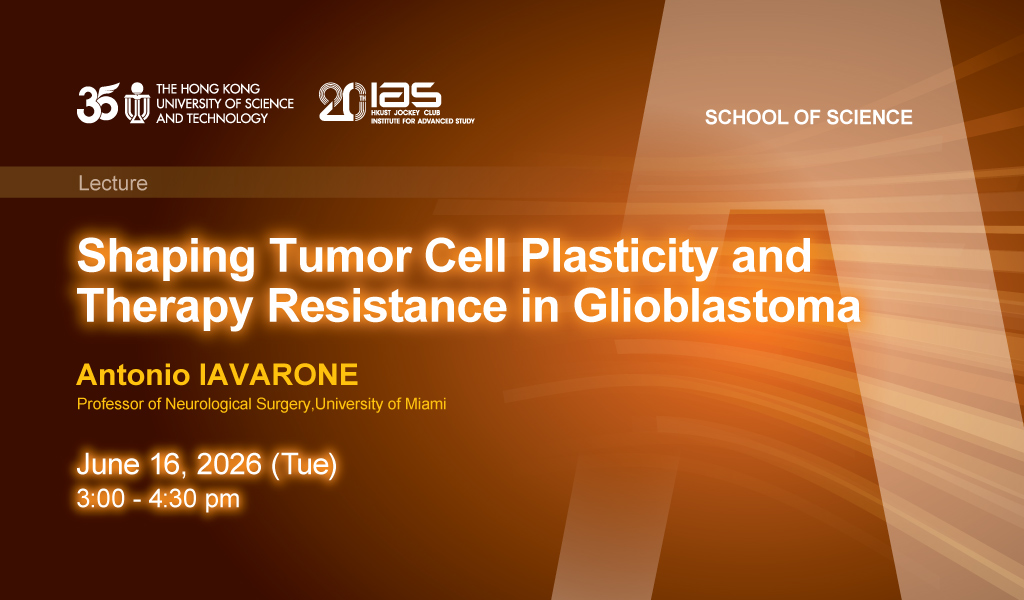
16 Jun 2026
Seminar, Lecture, Talk
IAS / School of Science Joint Lecture - Shaping Tumor Cell Plasticity and Therapy Resistance in Glioblastoma
Abstract
Tumor heterogeneity fueled by plasticity and genetic diversification of cancer cells is key to therapy failure of malignant glioma. The speaker's team implemented spatial and genetic p...
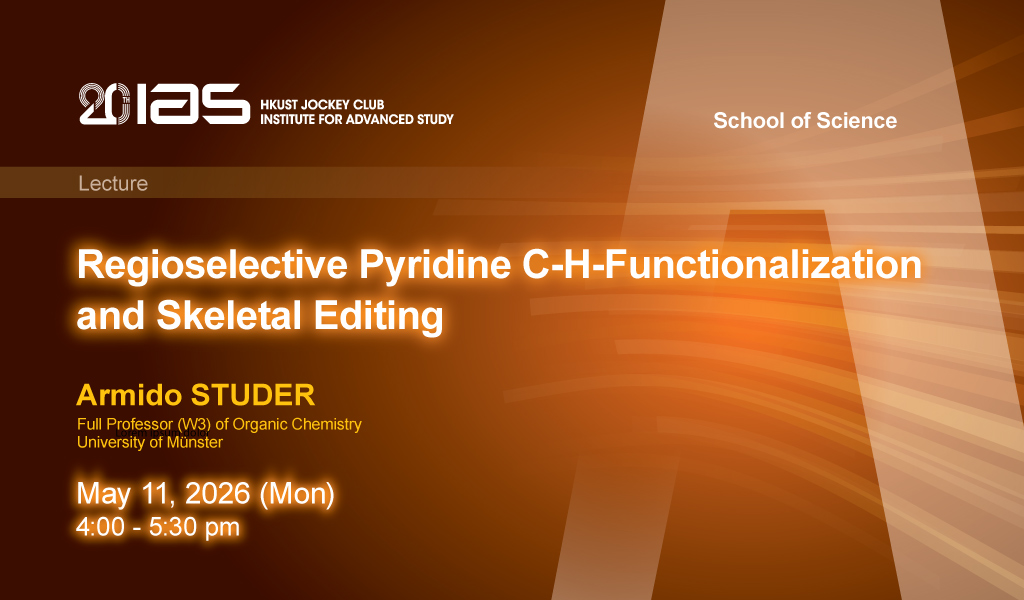
11 May 2026
Seminar, Lecture, Talk
IAS / School of Science Joint Lecture - Regioselective Pyridine C-H-Functionalization and Skeletal Editing
Abstract
Pyridines belong to the most abundant heteroarenes in medicinal chemistry and in agrochemical industry. In the lecture, highly regioselective pyridine C-H functionalization through a d...